Warning: Undefined array key "post_type_share_twitter_account" in /var/www/vhosts/casinonewsblogger.com/public_html/wp-content/themes/cryptocurrency/vslmd/share/share.php on line 24
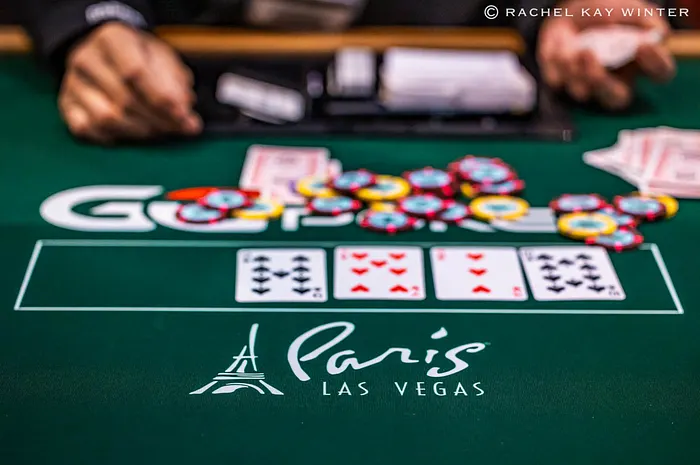
Think you could wear the suit and make the tough calls? In the heat of the WSOP, tournament directors can change the course of a player’s entire summer.
But they’re there to enforce the WSOP rules. We’ve all heard of some crazy rulings and penalties, but here we’ve pulled six scenarios based on the official WSOP rulebook to see if you’ve got what it takes to be a WSOP tournament director.
Read the scenarios, make your ruling, and check the answers at the bottom of the article. See how you stack up:
- 0-2: Bust before first break
- 3-4: Final Table performance
- 5+: Bracelet-winning effort!
Hand #1: The Oversized Chip
In a No-Limit Hold’em event, the blinds are 500/1,000. Player A bets 2,000. Player B, without saying a word, tosses a single 5,000-denomination chip into the pot. Player A immediately says, “I call your raise,” and prepares to add 2,000 more.
Player B stops him and says, “Wait, I didn’t raise, I’m just calling.”
You’re the TD: Is this a call or a raise to 5,000 from Player B?
Hand #2: Four’s Company
In a No-Limit Hold’em event, two players are heads-up to a flop. The dealer burns and deals a flop of A♠K♥10♦4♦ face up on the felt.
You’re the TD: What cards remain as part of the flop in this hand?
Hand #3: The Ambigious Raise
In a No-Limit Hold’em event, the blinds are 50/100. Player A opens to 325. Player B silently pushes out a 500-denomination chip and a 25-denomination chip simultaneously. They then look at the dealer and wait for 200 in change. The opponent, Player B, argues that this is a raise.
You’re the TD: Does Player A get change?

Hand #4: Five Big or Five Large?
In a No-Limit Hold’em event, the blinds are 200/400. Player A raises to 1,000 and gets one call. On the flop of A♥K♥K♠, Player B is first to act, and throws out a 5,000-denomination chip and announces “Five.”
You’re the TD: What is the size of the bet?
Hand #5: Betting the Pot
In a No-Limit Hold’em event, the blinds are 500/1,000 and two players are involved in a pot. Action is on the river of J♠J♦Q♥4♣10♣ with 15,500 chips in the middle. Player A is first to act and bets 3,000. Player B then declares, “I bet the pot.”
You’re the TD: What is the size of the bet?
Hand #6: Color Me Surprised
In a 2-7 Triple Draw event, the blinds are 4,000/8,000 and three players are involved in a pot. Action is just before the final draw. Player A draws two, Player B stands pat and Player C draws one.
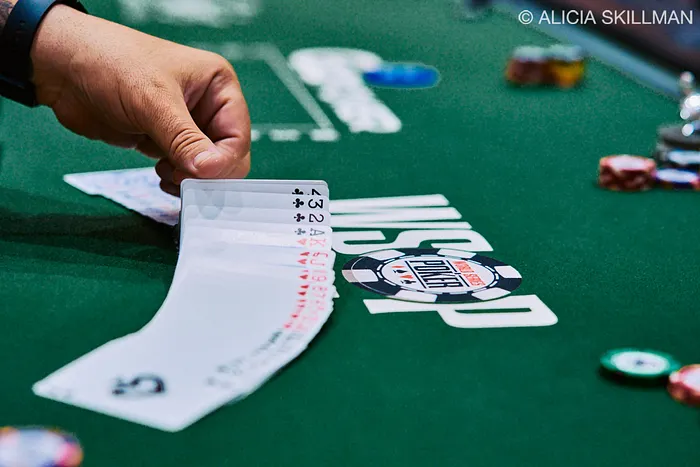
With the deck in their hand, the dealer spreads it to see roughly how many cards are remaining. Ten cards are remaining, however, the ninth card (second from bottom) has a Green back as opposed to a Blue one that matches all other cards in the hand. The solitary Green card is clearly visible, second from bottom in the stub.
You’re the TD: What happens next?
Answers
Hand #1
The Ruling: It is a Call.
Under Rule 97 (Oversized Chip Betting), putting a single oversized chip into the pot is considered a call if the participant doesn’t announce a raise first. To raise with a single chip, Player B would have had to verbally declare “raise” before the chip touched the table. Even though the chip is worth more than the bet, silence defaults to a call. Player B gets 3,000 in change back and play continues.
Hand #2
The Ruling: Shuffle the Four Cards.
Under Rule 89 (Four-Card Flop), if the flop contains four (rather than three) cards, whether exposed or not, the dealer shall scramble the four cards face down. WSOP Personnel will be called to randomly select one card to be used as the next burn card and the remaining three cards will become the flop.
Hand #3
The Ruling: It is a raise to 650
This is a classic violation of Rule 99 (Over-Betting Expecting Change). The rule states that betting action should not be used to obtain change. Because Player A put out two chips (a 500 and a 25) and the 500 chip alone was enough to call the 325, the addition of the second chip makes this a multi-chip bet. Under Rule 92, a silent multi-chip bet is ruled a raise if the amount is 50% or more of a legal raise. Since 525 is well over the threshold, Player A has just raised to 650.
Hand #4
The Ruling: It is a bet of 500
As per Rule 60 (Non-Standard and Unclear Betting), whenever the size of a declared bet can reasonably have multiple meanings, the bet will be valued at the largest amount possible that does not exceed the value of the pot. In this case, the pot is 2,600 at most, therefore the bet will be 500. If the amount of the pot was 5,000 or more, the bet will be 5,000.
Hand #5
The Ruling: It is a raise to 6,000.
Rule 102 states that declaring “I bet the pot” or similar in a limit or no-limit poker game is not a valid bet. However, it does bind the player to at least the minimum bet, if first to act. If they are facing a bet, as Player B is in this example, they will be require dto make at least a minimum raise.
Hand #6
The Ruling: Play continues as normal.
This particular hand falls under Rule 88, which covers Fouled Decks. According to the rules, if a card with a different color back appears during a hand, all action is void and all chips are returned to their respective bettors. However, it also states that if the errant card will not appear in any hand or on the board and substantial action has taken place, as in this example, all action stands.
Therefore, the players will each receive their cards after the final draw, and the final round of betting will be completed. The green card would then obviously be removed from the deck.


Managing Editor