Warning: Undefined array key "post_type_share_twitter_account" in /var/www/vhosts/casinonewsblogger.com/public_html/wp-content/themes/cryptocurrency/vslmd/share/share.php on line 24
Image courtesy of PokerGO Tour
In today’s article, we’ll cover one of the most important topics in all of poker strategy, which is how to make a correct decision facing a bet.
How do you go about figuring out when to fold, call, or raise?
As with most things in poker, the decision stems from several different factors, which, when put together, will give you a nearly perfect solution to this dilemma. So, let’s get into it.
Medium Defense Frequency – How Often You Need Not to Fold
The first thing to consider when deciding whether to continue in a hand is your Medium Defense Frequency (MDF). This number tells you how often you need not to fold so that you remain indifferent to your opponent’s bluffs.
The formula for calculating MDF is: 1-bet you are facing/(bet+pot).
So, if you are facing a pot-sized bet, your MDF will be 1-100/(100+100) = 1-0.5 = 0.5, which means that you need to defend with 50% of your range by either calling or raising.
Generally speaking, you should be defending more often when facing smaller bets (as you are getting better odds), and lower your defense frequency as the bet size increases.
For example, facing a 20% pot bet, our Minimum Defense Frequency increases to 83%, which means that we should be continuing with 83% of our range. If you fold significantly more than this, which is something that many players do, it is a pretty significant mistake.
However, things aren’t as simple as this, as every hand in your range needs to be able to realize its equity based on the pot odds. When you are facing a pot-sized bet, your pot odds are 33%, so that’s the minimum equity you need to realize with every hand that you continue with.
The best way to go about solving this problem is by coming up with a structured solution that works for every situation and allows you to implement a robust strategy.
Four Key Aspects in Decision Making
Based on the MDF, you know how often you need to continue, but how do you figure out which hands should be doing what, i.e., folding, calling, or raising?
There are four main aspects to consider:
- Hand type
- Nut advantage
- Stack depth
- Position
Hand Type
If you have junk, i.e., a hand like one over-card with no backdoor potential or a weak pocket pair on a board with all over-cards, you should just fold. There is no need to try and run some insane bluffs with garbage.
With marginal holdings, like a bottom or middle pair, a top pair with a weak kicker, or even an ace-high in some instances, calling is usually the best option.
The third category is premium hands and draws. These hands balance between calling and raising, and the decision is often influenced by one or more of the three remaining factors.
Nut Advantage
When facing a bet, we need to consider who has more nutted hands in the range. If you defend from the big blind against a UTG open, and the flop comes J66, you can have a bunch of 6s, while the UTG opener won’t have any. By the same token, on the flop of AKJ, it is the opener holding all the strongest hands.
As the nut advantage increases, you should be raising more often.
In terms of sizing, your raises should be smaller when you are in position (around 2.5x the bet) and larger when playing out of position (3x the bet or even bigger).
Additionally, you should also consider the opponent’s range connectivity with the board. On boards that they’re likely to connect with, you should be raising larger, as they are likely to continue. When the board is such that it doesn’t connect well with their range, like 754 vs. a UTG opener, you should utilize a smaller raise size.
Stack Depth
As you get deeper stacked, you get to call more bets with hands that have good implied odds, such as backdoor flush draws. If you do manage to improve with these hands and make your flush, you stand to win a big pot. With deep stacks, you should also use large raise sizes, as this will help you get all the chips in the middle by the river.
When playing shallower, implied odds become less relevant as the amount of money you can win is limited, so you should be folding these types of hands more often, and your raises should be on the smaller side as you won’t have any problems getting all the chips into the pot if you’re playing 25 – 30 big blinds deep.
Your Position
Finally, you need to consider your position when constructing ranges. Out of position, you should be more inclined to raise your draws and avoid difficulties of playing these hands when you fail to improve.
You should be doing a lot of check-raising playing out of position, and this is one aspect that many players get wrong.
In position, you should be calling with a much bigger chunk of your range. The GTO strategy suggests raising out of position at a frequency of 20%, 30%, and even 40% in some spots. In position, however, raises are quite rare, and calling is usually the default option.
Bet Response Flow Chart
The best way to put this knowledge to use is through a best response flow chart. You can follow this chart to figure out the best response in pretty much every situation.
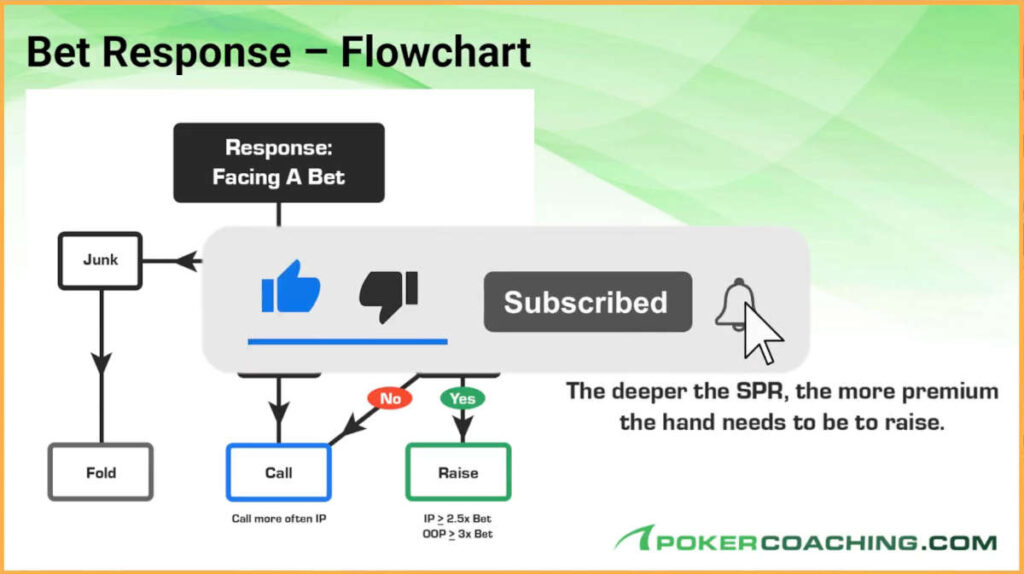
So, first we decide what category of the three our hand belongs to (junk, marginal made hand, or premium/draw). If it is a premium or a draw, we have to figure out if we have the nut advantage to decide whether to call or raise.
Of course, our stack depth and stack-to-pot ratio (SPR) are considerations. The deeper we are, the better hand we need to raise. It’s perfectly fine to get all your chips in the middle with a top pair-top kicker playing 25 big blinds, but if we have 300 big blinds and the opponent is willing to go all the way, our top pair is probably in really bad shape.
Make it a habit to follow this process with every hand you play, and you’ll usually end up finding the best play in every spot and, by doing so, making more money than a great majority of your opponents!