Warning: Undefined array key "post_type_share_twitter_account" in /var/www/vhosts/casinonewsblogger.com/public_html/wp-content/themes/cryptocurrency/vslmd/share/share.php on line 24
Image courtesy of World Poker Tour
Math is important in poker, especially the math that actually impacts your strategy. To succeed in the game, you need to have a good grasp of fundamental math concepts.
Many players focus on things that don’t really matter, like how often your quads will lose to a royal flush or how likely it is to lose with pocket aces four times in a row. These things may be somewhat interesting to think about, but they are actually completely irrelevant.
If you want to learn how to play poker, you need to focus on things that have a direct impact on your strategic decisions. In this article, I’ll cover five of these core concepts. So, let’s dig in!
#1 Pot-Sized Bets / Raises
The size of the pot is a good starting point for your raises before the flop. It is an amount that doesn’t give your opponent amazing odds, while you don’t have to risk too much.
The formula for calculating the pot size is: three times the last bet plus any additional money already in the pot.
So, for example, if a player raises to $6 in a $1/$2 game, the pot size raise would be 3x$6 + $1 + $2 = $21. If there are also antes in play, you can make it slightly bigger.
The size of the pot is a good starting point. However, you should also consider the stack size. As stacks get deeper, you’ll want to make your raises bigger. Likewise, with shorter stacks, you can go for smaller raises.
Your position comes into play as well. Go for larger raises when you’re likely to be out of position and default to a smaller sizing when you expect to be in position.
Finally, if the raise represents more than 30% of your stack, you should go all in instead. This is particularly important in tournaments, where stacks are usually shallower, but it is also a good rule of thumb in cash games, in spots where you’re considering a 5-bet.
The table below shows recommended raise sizes, whether you’re first in, facing a limper or a raise, or against a 3-bet, depending on your stack size.

#2 Pot Odds
When facing a bet, you have to risk some amount to win some other amount. You have to match the amount of the bet in order to win the bet plus the pot, as well as get your bet back.
In the simplest of terms, when considering your decisions, if you expect to win more often than pot odds dictate, you should call; otherwise, you should fold.
Pot odds are usually expressed as the amount you can win to the amount you have to risk.
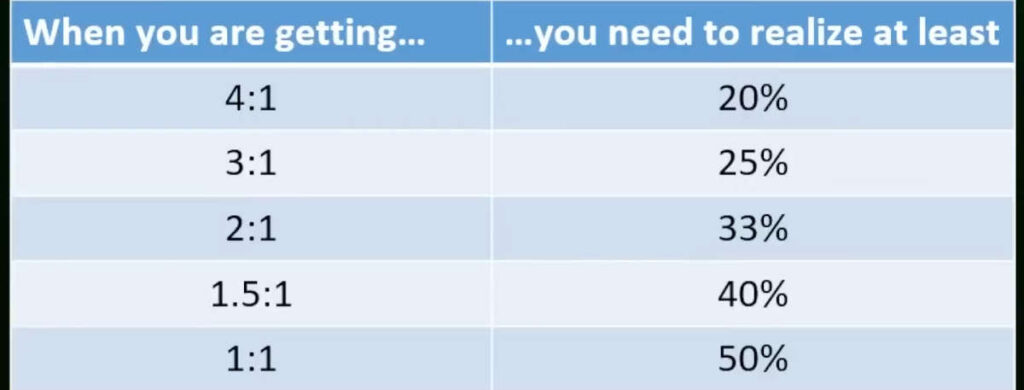
If your opponent bets 100 into a 100 pot, you have to pay 100 to win 200. This gives you two to one odds. But, how often do you have to win in terms of percentages? To get this number, you need to divide the second number by the first number plus the second number.
- So, in this case, it is 100/(100+200) = 100 / 300 = 33%.
Thus, you need to win 33% of the time when facing a pot-sized bet, which makes sense, since you’re putting in a third of the pot to win the whole thing.
Here’s another example. Say your opponent bets 100 into a 400 pot. This gives you 4 to 1 odds, or, converted to percentages, 100/(100+400) = 1/5 = 20%.
The table below shows some of the most common pot odds that you can learn by heart to save you some time in situations that come up frequently.
#3 Balanced River Bluff to Value Proportion
This particular topic is the one that people don’t consider nearly enough when talking about a balanced poker strategy.
When you bet the river with a perfectly polarized range, your opponent will be indifferent with all of their bluff catchers.
To have a balanced range, you want to have a number of bluff combinations in your range equal to how often the opponent needs to win based on the pot odds.
This concept is very important when you take a line where you should be very polarized. However, you have to make sure that all your value bets win when they get called.
If you are value betting too thinly, you have to need fewer bluffs in your range to account for this fact.
Let’s say you bet all in on the river for 50% of the pot. Here, your opponent needs to call 0.5 pot to win 0.5 + 0.5 + 1, which translates to 25%.
Your opponent needs to win 25% of the time, which means you want to structure your river all-in range so that it contains 25% bluffs. Many people bluff too often in this spot, and your opponent can call with all of their bluff catchers to crush you.
Let’s look at some other scenarios:
- When you bet 100% of the pot, they need to win 33% of the time.
- If you bet 200% of the pot, they have to win 40%.
- When betting 300%, they need to win 43% of the time to call profitably.
Most players in most games don’t have nearly enough bluffs in their range when they bet big on the river, making it easy to find a fold. However, the best players in the world will often do this, especially when they have good blockers, putting their opponents in tough spots.
#4 Required Bluff Success Frequency
This particular concept is often confused with pot odds, but the required bluff success frequency is not the same thing as pot odds.
Simply put, if your bluff wins more than your bet divided by your bet plus the pot, you profit immediately. This presumes your bluff has zero equity, which is usually not the case, as some bluffs will improve.
For example, you bet 25% of the pot on the flop. You profit if your opponent folds more often than 20% of the time. You make immediate profit even if your hand never wins on a showdown, which means that they need to defend quite a bit more than 20%.
In many smaller stakes games, these small bets will be extremely profitable, as players will fold things like gutshots and backdoor flush draws with an overcard, which is a pretty big mistake.
If you bet the pot, you profit if they fold more than 50% of the time. Facing a pot-sized bet, many players fold way more often than this.
#5 Minimum Defense Frequency
The minimum defense frequency (MDF) is the exact opposite of the previous concept, as it shows how often you need to call to ensure you’re indifferent to your opponent’s bluffs.
- The mathematical formula is: 1 – bet/(bet+pot)
So, for our first example, that would be 1 – 0.25/(0.25+1) = 1 – 0.20 = 80%.
Many people study MDF, and they think they need to defend with 80%, but the fact is that sometimes you will under-realize your equity.
For example, if you defend with 9-5 from the big blind and the flop comes A-K-, you can call a flop bet. However, a T comes on the turn, your opponent bets again, and you’ll probably have to fold, even though you’ll have the best hand some of the time.
This means that, when there are additional betting rounds to come, you don’t necessarily have to defend as often as the MDF suggests.
This number is most useful on the river, when there are no additional bets and no more cards to come. It helps you create a strategy against good, balanced players, where you’re not over-folding against their river bets. Instead, you’ll have enough solid hands that you can check-call with to counter their bluffs.
These are five fundamental concepts that you need to master if you want to be a winning player. They will help you structure your game around actual, meaningful numbers, resulting in much better decisions across the board.