Warning: Undefined array key "post_type_share_twitter_account" in /var/www/vhosts/casinonewsblogger.com/public_html/wp-content/themes/cryptocurrency/vslmd/share/share.php on line 24
A few months ago, Jarred Gabin and Shaundle Pruitt embarked on PokerCoaching’s Hero’s Journey with a simple objective: find out how far elite coaching, accountability, and a commitment to improvement could take them.
Today, the challenge feels very different.
Gabin is up roughly $30,000, has captured his first live tournament title, and believes the breakthrough he has spent years chasing may finally be happening. Pruitt says the late-game and ICM work introduced through the project has already paid significant dividends, while Justin Saliba believes both players have undergone a fundamental shift in their approach to tournament poker.
In other words, the road to $100,000 is starting to get real.

Aggression Is Changing Everything
According to Saliba, the biggest transformation in both players’ games hasn’t come from learning a handful of new concepts or memorizing more solver outputs.
It’s been about becoming significantly more aggressive.
“I think the number one improvement that I’ve seen has been increased aggression across the game,” Saliba said. “More betting, more check-raising, more 3-betting, fighting hard for pots constantly and always trying to be the most aggressive, logical player at every table.”
That mindset becomes even more important late in tournaments, when chips are more valuable, and players often default to caution.
Saliba believes that is exactly where Gabin and Pruitt have made some of their biggest strides.
“Keeping that aggression up in the late game may be even a bigger difference,” he said. “Now, Jarred and Shaundle are an absolute problem when they have the chip lead deep in tournaments. Leaning on the middle stacks and just being more aggressive than they can even imagine to really take over the tournament and go for the win.”
For Pruitt, that work has translated into tangible improvements.
“It’s difficult to point to one area,” he said. “But I’d say late-game and ICM work has paid the most dividends.”
Why Players Struggle to Move Up
One of the central themes of Hero’s Journey has been exploring what separates solid small- and mid-stakes players from those capable of succeeding at the next level.
Saliba believes the answer is often counterintuitive.
“I think every time a player moves up, they become a tighter version of themselves,” he said.
Players stop bluffing as frequently, avoid marginal spots, and become overly focused on survival. They pass on profitable opportunities because buy-in suddenly feels bigger and the pressure feels greater.
“They play too tight on the bubble because it means more for them to cash than at their normal buy-in levels,” Saliba explained. “They won’t put their stack at risk because they really want to get it in with the best hand.”
The problem, according to Saliba, is that stronger opponents recognize those tendencies immediately.
“If you play too tightly when you move up stakes, you will get found out,” he said. “Opponents are better, and they will take advantage of you in ways that people at your previous buy-in levels won’t.”
Confidence plays an equally important role.
Saliba believes technical skills are often enough to help players transition from small-stakes to mid-stakes games, but the jump beyond that point becomes increasingly psychological.
“For the majority of players moving from small to mid-stakes, it’s a technical improvement that is needed,” he said. “Moving from mid-stakes to high stakes, though, that’s all about mindset and confidence.”
“There is nothing technical that prevents Jarred or Shaundle from being a solid winner in an online $1,000 WSOP bracelet event or a marquee WPT Gold $530. It’s above their current average buy-in, and the importance of the tournament tends to loom.”
“If they play those games with confidence and don’t treat them any differently than the $110s they play constantly, they’ll find win-rates there.”
A Breakthrough That Feels More Real
When Pokerati first spoke with Jarred Gabin, he described Hero’s Journey as one of his last real opportunities to break through.
Months later, that mindset hasn’t changed.
“Yeah, I’ve definitely kept that mindset,” Gabin said. “It’s kind of what pushes me to keep grinding and putting in the volume.”
The results have helped reinforce that belief.
“A lot’s happened since we last talked,” he said. “I was just coming out of a downswing back then, and I’ve been able to ride that the other way. I am up about $30K now.”
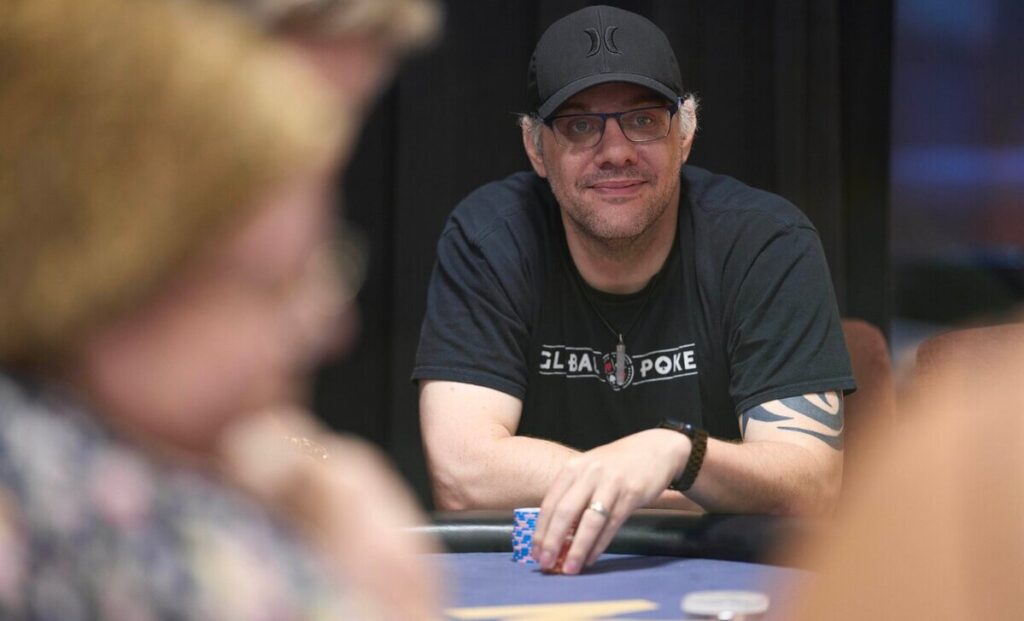
Gabin also recently captured his first live tournament victory at The Orleans during its Summer Series.
“I didn’t realize the ring was a thing until we hit the final table and they announced it,” he said. “That was a nice surprise and a really cool way to memorialize the first live win.”
More importantly, he feels like the work is starting to compound.
“It feels like things are starting to click and the breakthrough is happening,” Gabin said. “At least at the stakes I’m playing right now.”
Part of that progress has come from cleaning up smaller leaks that had quietly impacted his results over time.
“My foundation was always solid, but it was kind of a death-by-a-thousand-cuts situation,” he said. “I was losing little bits in a lot of spots.”
“I was too tight preflop in some areas, wasn’t going for thin value enough, and didn’t fully understand certain ICM spots.”
Gabin credits much of his recent improvement to the late-game strategies Brock Wilson has emphasized, combined with Saliba’s focus on pushing equity harder and extracting thinner value.
“That part’s been huge,” he said. “It not only gets you paid by worse more often, but it also keeps you out of tough guessing spots where you might end up making costly calls. It’s really started to compound.”
The Value of a Process
While results naturally grab attention, Saliba believes Hero’s Journey has always been about something larger than profit.
At its core, the project is designed to build a repeatable process for improvement.
“I would say the number one thing to do is set up a process to improve,” Saliba said.
At PokerCoaching, that framework revolves around what Saliba describes as Learn, Train, Improve, and Perform.
There are passive learning moments, hand reviews, and coaching sessions. Then come repeated drilling, training key spots, and reinforcing those ideas until they become instinctive.
That foundation eventually leads to improvement.
But there is one final step.
“We have to hold ourselves to a high standard and perform and execute at the table to the best of our ability,” Saliba said.
“No matter if we’re running hot or running cold, we have to do our best to play our best consistently and keep the belief that if we nail that process, everything else will work out.”
For Pruitt, that philosophy extends beyond Hero’s Journey itself.
After years of hosting study groups and helping other players improve, he says the project has simply given him another set of concepts to bring back to his own students.
“It just gives me an opportunity to rehash and drill with my students in the groups the concepts I picked up in my sessions with Justin and Brock,” he said.
What has stood out most isn’t necessarily strategy, but the mindset behind elite performance.
“The sheer dedication and commitment to improving all the time,” Pruitt said. “These guys don’t let up and are always looking for ways to improve their own games. They’re never complacent.”
He believes that lesson applies to every player trying to move up.
“It takes a tremendous amount of work to get to the level of players like Justin and Brock,” Pruitt said. “But without the right attitude, work ethic, and expectations, you’re drawing dead.”
“Being a world-class player is deeper than just being technically superior to your opponents. You have to strive to be the complete package.”
Looking Ahead
When Hero’s Journey began, the $100,000 goal felt ambitious.
Today, it feels increasingly attainable.
“I think it means the same thing at its core,” Gabin said. “It’s about building real freedom as I start thinking about stepping away from my day job.”
“At the start, $100K was more of a nice, ambitious target, but being at $30K already and seeing consistent results both online and live, it’s starting to feel very achievable.”
“We’re well on our way, and that’s made it a lot more exciting.”
The road ahead remains long.
There will be downswings, difficult decisions, and plenty of tournaments still left to play.
But after months of coaching, study, and deliberate practice, one thing has become increasingly clear.
Hero’s Journey isn’t just documenting whether two players can reach a number.
It’s showing what can happen when talented grinders combine elite coaching, accountability, and a commitment to improving every single week.