Warning: Undefined array key "post_type_share_twitter_account" in /var/www/vhosts/casinonewsblogger.com/public_html/wp-content/themes/cryptocurrency/vslmd/share/share.php on line 24
Image courtesy of PokerGO Tour
In today’s article, we’ll focus on strategies that will help you crush your opponents in multiway pots. These are scenarios that many players, even those who have experience in the game, often struggle with.
Multiway pots are different from heads-up situations in several important aspects, and we’ll address some of the most important ones in this lesson.
To start, let’s go over some basics and take a quick refresher on the crucial concepts that you always need to keep in mind.
Multiway Pot Strategy Essentials
In pots involving multiple opponents, range and nut advantage are the main factors that dictate how we should play. Both of these are substantially reduced, as there are more people who can wake up with the nuts.
If you want to play a good GTO strategy, you should keep in mind that you should almost never bet 100% of the time in these scenarios. In fact, as we’ll see, there are quite a few spots where we are supposed to check with everything.
In terms of bet sizing, we are never using massive bets. Small c-bet sizes are preferred in most situations, and larger bets are around 60% of the pot (and not 100%+ as we see in some heads-up scenarios).
With multiple players in the pot, the Minimum Defense Frequency (MDF) and your equity realizations will be reduced. Facing a bet, we get to fold many combos like an over-card plus a backdoor flush draw, which we would likely continue with in heads-up situations.
At the same time, the idea of cleaning up equity gains more merit, especially when playing in position. For example, we’d almost always check with a hand like pocket tens on a J-8-6 board in a heads-up pot, but, multiway, betting small some of the time to fold random over-cards becomes a feasible strategy.
Otherwise, our betting ranges are much more linear, and there are very few no-equity bluffs in our range. We’re not playing nearly as aggressively as in heads-up situations and should be using smaller bet sizes across the board.
Multiway Hand Example 1
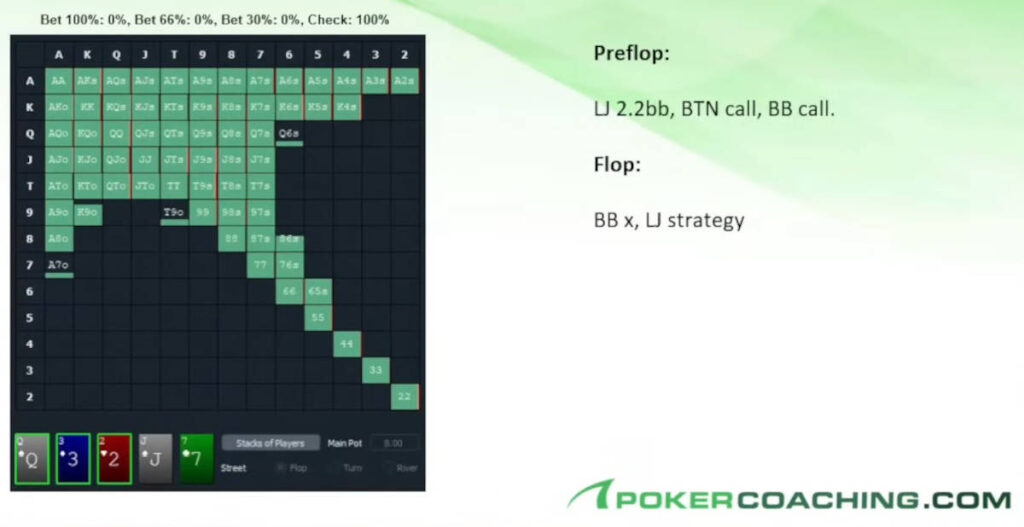
Playing 40 big blinds, we make a standard open to 2.2 big blinds with K♠K♥ from the lojack. The button and the big blind call. The flop comes Q♠3♦2♥, and the big blind checks.
This is a spot where most players will fire a continuation bet, and that’s actually wrong from the GTO point of view. If we think about our hand range and compare it to that of our opponents’, we are not really in great shape.
We have a very tiny portion of the range that is effective nuts. The button and the big blind have pocket twos and threes, and the button can also have hands like AQ and KQ. Thus, we don’t really have much of a nut advantage in this spot.
The GTO strategy here, perhaps somewhat surprisingly, is to check everything. When we do check, we’re probably looking to get in a check-raise, but we start by checking everything.
Why does this happen to be the case? The chart below shows equity distribution, and the markings are a bit off on the picture (the SB is actually BB, and the BB is the hero (LJ)).
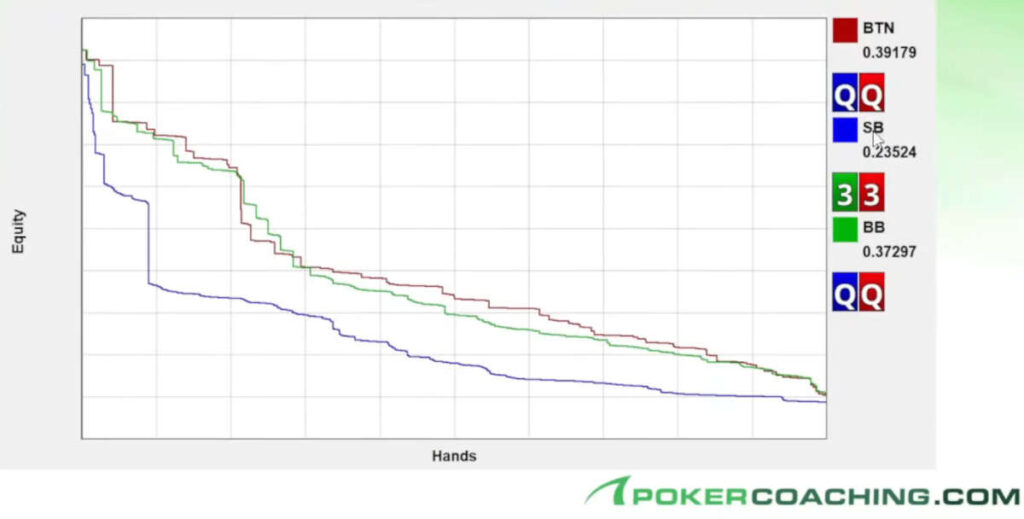
On the left side are our best possible hands, and on the right is the bottom of our range. You’ll notice that the line in green, which is our equity line, is actually below the button’s line across the board, except for a small portion in the middle. So we really don’t have much of an advantage here.
Additionally, our kings aren’t particularly vulnerable, so we don’t need much protection on this particular flop.
If the action checks through on the flop and the turn comes J♠, what are you supposed to do when the big blind checks their option?
We’ll want to bet quite frequently because the board is now getting coordinated, and when the action checks through, our opponents’ ranges are starting to get capped. This means we’ll want to start betting and use a bigger sizing of like two-thirds of the pot.
Multiway Hand Example 2
We have 9♠9♥ in the LJ, open to 2.2 big blinds, and get called by the button and the big blind player. The flop comes J♣8♥6♦ and the big blind once again checks to us.
Compared to the previous hand, this board is substantially more dynamic, i.e., likely to change on later betting rounds. On these boards, we typically bet a bit more often.
When we do bet, we’ll be betting tiny, about a third pot. The GTO strategy, as shown below, suggests we bet 66% about 9% of the time, 30% about a quarter of the time, and check the rest.
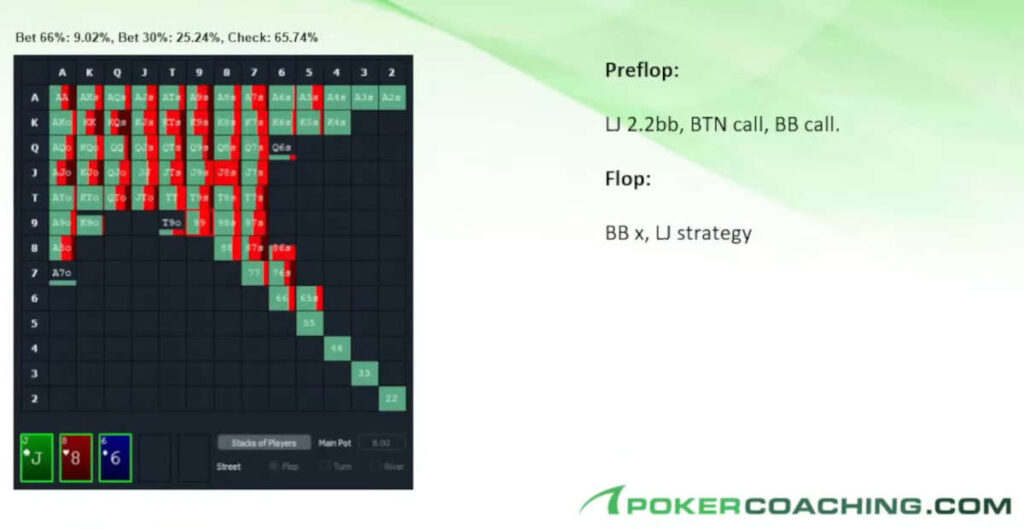
Out of position, you’ll always be using mixed strategies, because we have to have some check-raises both as value and bluffs, and make it not very clear for other players what they should do.
I will say, if you wanted to simplify things and just use one sizing of one-third pot across the board, it’s perfectly fine. You might lose a bit of EV, but it doesn’t matter that much, and it will make it easier to avoid mistakes.
Multiway Strategies When Facing Aggression
As already mentioned, when facing a bet in multiway scenarios, we should call significantly tighter and over-fold compared to MDF, especially when we are not closing the action.
If you’ll be betting and raising in these scenarios, you’ll want to have pretty good equity.
Let’s look at another example.
We open from the LJ with A♠Q♣, the button and the big blind call, and the flop comes A♥K♠5♣. After the big blind checks, we can mix between checking and betting, and this time we decide to check.
After we check, the button goes for a small bet of two big blinds, and the big blind calls. How should we proceed in this spot?
In heads-up spots, facing small bets out of position, we have an incentive to check-raise. Hands to do it with are our best aces, as well as hands like gutshots and bottom pairs. With bottom pairs, we usually have five clean outs to improve.
As you can see, the solver check-raises with AT+, hands like A9 and A8 can get away with it, A5, A4, and A2, as well as some draws. However, notably, we are not check-raising hands like A7 and A6 with a flush draw.
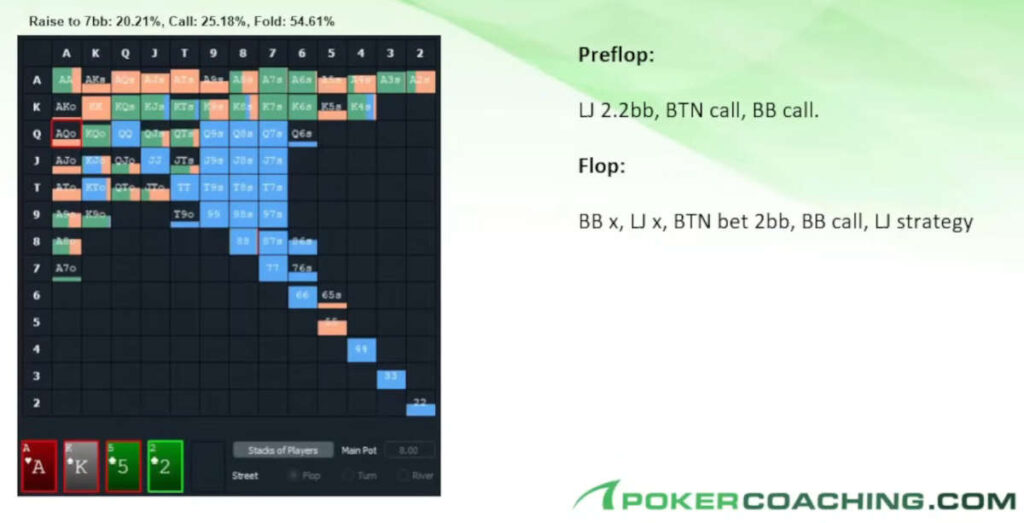
Notably, facing a bet and a call, the solver folds hands like KJ and KT a decent chunk of the time (or raises as a bluff). However, K7 and K6 call all the time, and this is because these hands are very live to improve to two pair. With KJ, hitting two pair doesn’t always have to be good, as the jack will improve a lot of opponents’ holdings as well.
It will take some time and effort to implement these and other adjustments talked about in the video into your strategy. However, they will help significantly improve your results, as many of these spots and decisions aren’t super obvious, and knowing what to do will put you well ahead of a good percentage of your opponents, especially at lower stakes.