Warning: Undefined array key "post_type_share_twitter_account" in /var/www/vhosts/casinonewsblogger.com/public_html/wp-content/themes/cryptocurrency/vslmd/share/share.php on line 24
Image courtesy of the World Poker Tour
In this article, we’ll focus on the strategy of playing as a preflop aggressor when we find ourselves out of position. So, essentially, we raise, someone makes a call in position, and the blinds fold.
In these spots, our betting frequency is determined primarily by the range advantage.
Unlike when playing in position, i.e., when we open, and one of the blinds calls, we’ll be facing a much tighter and more condensed preflop range when playing out of position.
The opponent won’t be calling with all the different weak suited hands and offsuit gappers, so our range advantage is, generally speaking, significantly smaller. This concept applies across different poker variations, but it is particularly essential in Texas Hold’em.
Determining the Range/Nut Advantage
So, how do we go about determining the range/nut advantage in these spots?
If we look at the lojack raise against the big blind, we see that the out-of-position player has about 39% range advantage, while the in-position player has nearly 61%.
However, against the button call, the lojack (who is now OOP) has about 29% range advantage, while the IP player has nearly 61%.
Looking at the range advantage flowchart, the frequency for continuation betting out of position is determined by how favored you are. On some boards, we are still betting quite frequently, but, for the most part, our c-bet percentage is between 25% and 75% on the flops that are okay for our range.
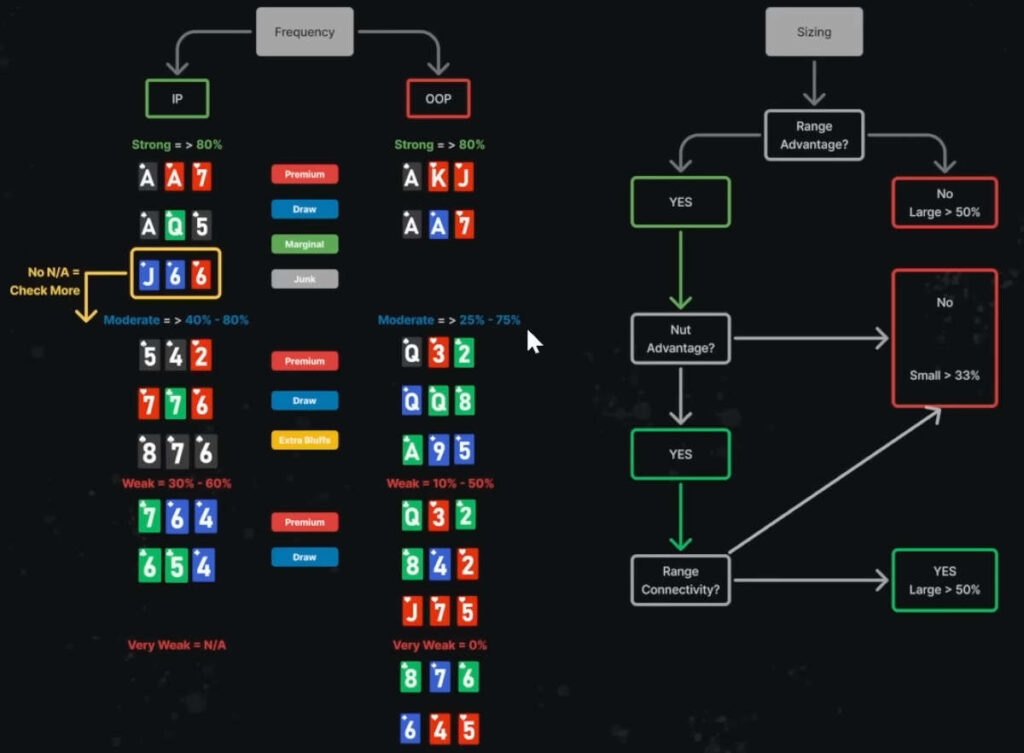
On the boards that are not that great, such as three to a flush or all low cards, we are betting infrequently and sometimes not at all.
The general rule of thumb is – the higher your equity is above 50%, the more often you’ll want to continuation bet.
If you could simply look at the configuration of preflop ranges and the board, and calculate your equity across the entire range, it would be easy to figure out the correct c-bet percentage. However, this is extremely difficult to do on the spot.
A good way to go about it is by using three concepts that can help you quantify the OOP range advantage:
- Position proximity
- Card gapping
- Range asymmetries
Each of these concepts acts as a slider that goes up and down. The better these factors are for you, the more often you’ll be betting.
Position Proximity
The first concept is exactly what you’d think it is – it defines how close you are in terms of the position to the caller. The closer you are, the less c-betting you’ll be doing, as their range gets stronger.
Using that logic, the highest c-bet frequency will be when you open from UTG, and the button makes the call. You are opening with a very strong range, and their calling range on the button should be quite loose.
The closer you get to the caller, though, the stronger their range becomes compared to your range.
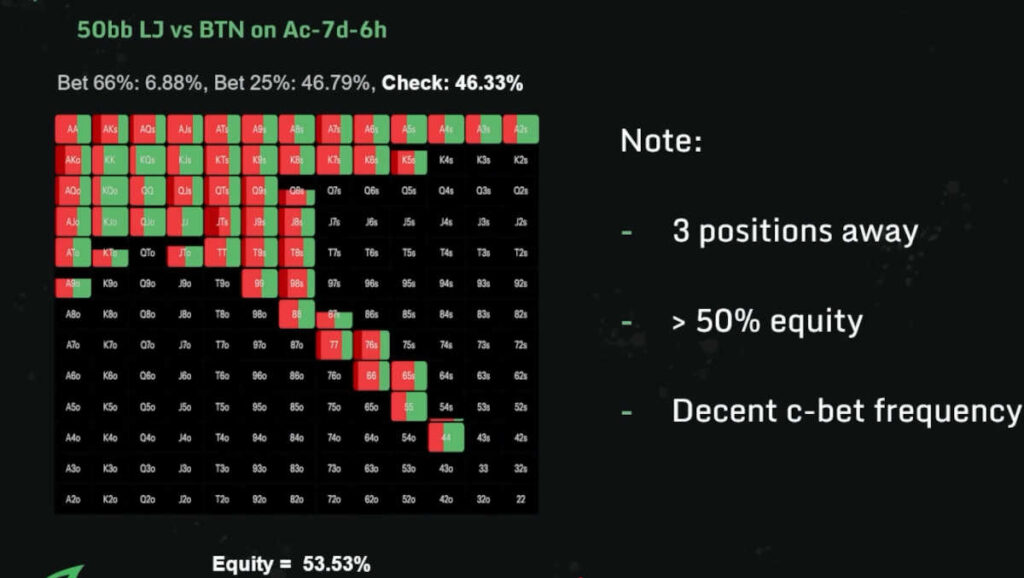
If we look at an example of lojack vs. hijack on the flop of A♣7♦6♥, we’ll see that we don’t get to c-bet very often in this spot. The caller is just one position to the left, and their range is tighter on the bottom end, missing some of the best hands.
Although we have a lot of aces in our range, that’s also true for our opponent, and they don’t have any of the junk that we are opening with (as they fold all those hands facing a raise). This means we don’t have much of a range advantage at all and should check a lot.
If we move the caller position to the button, we see that we are betting more often. Although our raising range remains the same, the button’s calling range is much wider, so we have 53% instead of 48% equity.
Card Gapping
The concept of card gapping describes the size of the gap between cards on the flop, i.e., how far they are in terms of rank.
Examples of high card gaps are flops like A-2-8 and T-3-2; low card gap examples are flops like A-K-Q, T-8-5, and 6-6-5.
The larger the gaps, the less continuation betting you should be doing, because you won’t have that many hands that want to put money into the pot. As the board gets more connected, assuming it is decent for our range to begin with, we’ll be betting more frequently.
So, if we look at the flop of K-Q-8, this is a texture where we have more premium hands and draws, which means we can bet more often. On a board of K-5-2, though, we have more marginal hands and junk, leading to a smaller range advantage and more checking OOP.
Looking at the charts for these types of spots, we see that we have a decent equity in both scenarios, but we are betting more often on a flop of K-J-8, where gaps are much closer. On a flop of K-3-2, we have a big chunk of suited broadway hands that simply don’t connect with the board at all.
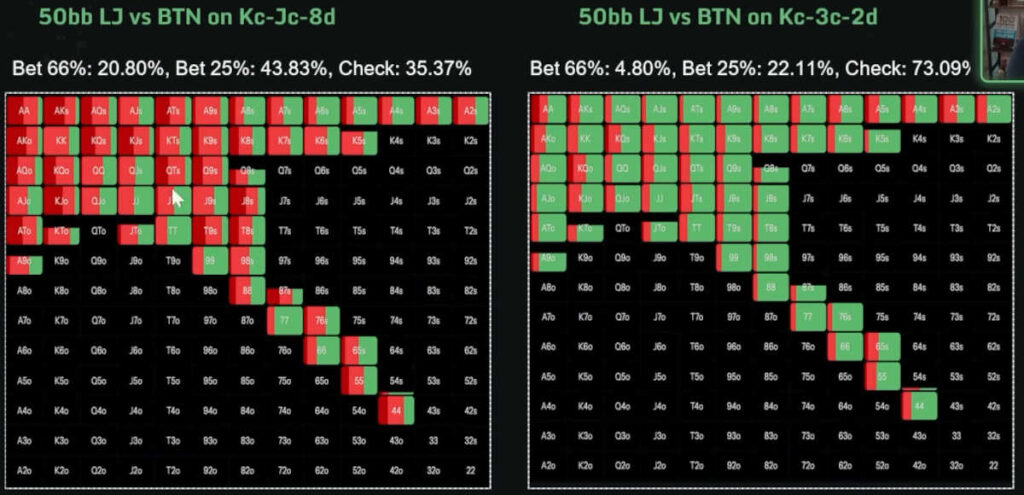
The long and short of it is, when betting out of position, you’d rather have bluffs with some equity, and it’s much harder to find those hands on very disconnected boards.
Range Asymmetry
The concept of range asymmetry relates to the section of offsuit hands in the preflop range that is unique to one player. This idea becomes important in OOP spots, because you need to know which boards are better for the preflop raiser based on their range, and which ones are better for the IP’s calling range.
If we look at the lojack preflop raising range and the button’s calling range, which offsuit hands does the LJ player have that the button caller does not?
For example, we can see that the LJ is opening with hands containing a ten, whereas the button is either 3-betting or folding these hands. Also, J-X hands, the button player calls sometimes, but also 3-bets some of the time, and they don’t have any TJo.
That leads to the conclusion that J-high and T-high boards are much better for the OOP raiser (HJ) than the IP caller (button).
If we consider K-X-X boards, both players have a lot of hands containing a king, so these boards will result in a lot of checks.
What about the situation where the CO raises and the button calls?
In terms of the range asymmetry, CO’s raising range contains many 9-x offsuit hands, whereas the button doesn’t have any of these hands (except for A9). There are also quite a few T-x hands not in the button’s range.
Let’s look at a couple of examples where these asymmetries come into play. If we take the CO vs. BTN scenario on J♦J♣7♣ and on 9♦9♣7♣ flops, what are the differences?
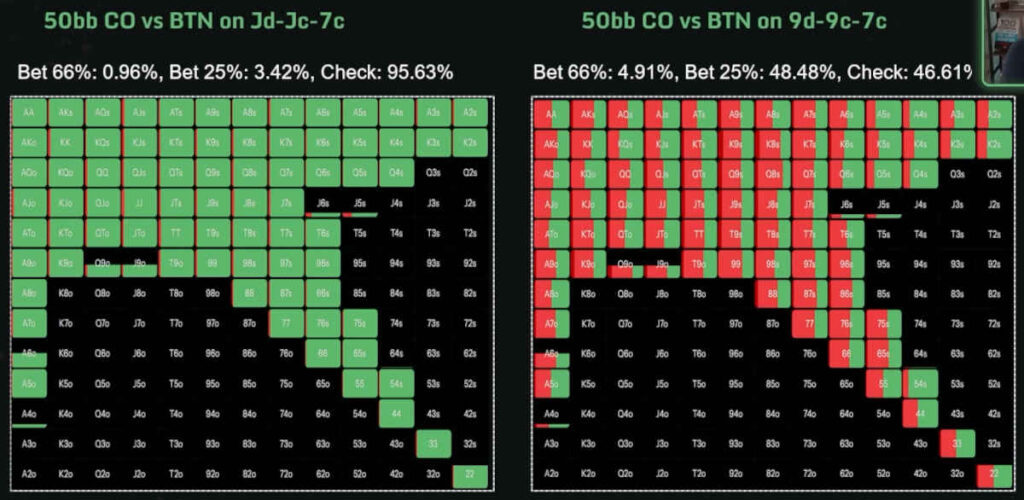
Both players have a decent number of J-x in their range, so the CO has to check all the time on the J-J-7 board. However, on the 9-9-7 board, the CO has all the 9-x hands in their range, whereas the button doesn’t have any, so the CO can bet far more often on the second flop.
These three concepts, position proximity, card gapping, and range asymmetry, can help you navigate the OOP spots as the aggressor much better.
Keep in mind that the range advantage is the key aspect in determining if and when to bet, and understanding these concepts will significantly improve your overall understanding of ranges and how they interact with different flop textures.