Warning: Undefined array key "post_type_share_twitter_account" in /var/www/vhosts/casinonewsblogger.com/public_html/wp-content/themes/cryptocurrency/vslmd/share/share.php on line 24
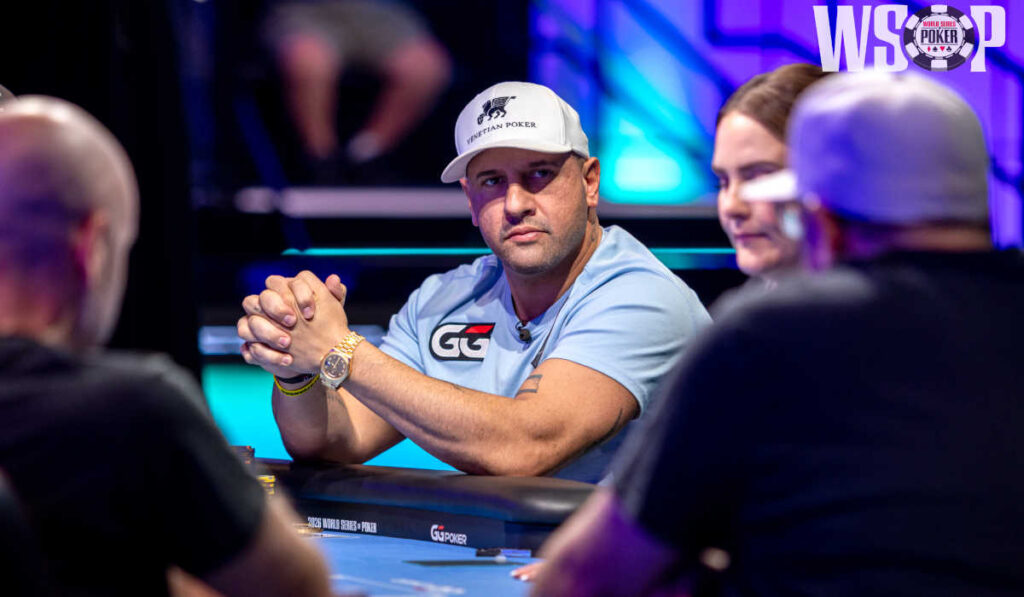
Image courtesy of the World Series of Poker (Monique Marestein)
Once the bubble burst on Day 4 of the Main Event at the 2026 World Series of Poker, all players still in it were guaranteed a min cash of $15,000. Is that life-changing money? No, it’s more like change-making money, but the ability to make change is very much appreciated at my home game or when you’re out to dinner with a group of 8 and one person says, “All I had was a Skinny Margarita.”
The real goal in the Main is, of course, to be the last man standing, but 15K is a lot better than being the last man thrown off the island before the girls in grass skirts show up for the luau.
That’s what happened on Day 4 to none other than 2003 Main Event Champion, Chris Bubblebreaker… pardon me, Chris Moneymaker, along with two other players simultaneously.
For the uninitiated, in all poker tournaments, when there are only a few players left until the money, the game is played one hand at a time (for the initiated, stand by for a joke). When the hand at each table is completed, dealers are instructed to stand.
Only when all the dealers are standing does the floor finally say, “You put your right foot in, you put your right foot out, you put your right in, and you shake it all about, you do the hokey pokey and turn yourself around, that’s what it’s all about.”
Sorry, I’ve been to one too many children’s birthday parties. Which is to say I’ve been to one children’s birthday party.
In reality, if no player or players have been eliminated and the bubble is still unbroken, another hand is dealt at each table. This continues until enough players have been knocked out to put everyone remaining in the money.
Bubble play is a game within a game. In the hour or so leading up to hand-for-hand play, the players with healthy stacks seek to exploit the bubble by pushing out opponents who are just trying to hang on until the money.
Medium stacks take some risks but are also trying to keep their powder dry for the real battle to come. Short stacks have a dilemma: try to get it in good or just fold into that folding money.
I confess that frequently, when I am in a tournament, I stagger to the bubble very low on chips. I’m a good staggerer, but quite frequently, just after making the money, I go broke for a min-cash or slightly better than a min, as I did this year in the $1,000 Seniors and in the Main Event of the Irish Open in Dublin.
But I’ve also made some decent runs. At the Wynn a few years ago, I was playing in a $500 Event at the Summer Classic. If you made Day 2 in this one, you were in the money.
I found myself at the end of Day 1 with exactly seven big blinds, and just before hand-for-hand play began, I was moved to a new table made up of players I didn’t know, who mostly had big stacks.
My plan of attack was Operation Origami: keep folding. I was sticking with that plan when it was folded to me on the button, and I looked down at pocket sevens.
This would normally be an all-in shove, but I looked at my remaining opponents in the blinds. They both had huge stacks, and I thought there was a good chance they would both call, in effect teaming up to knock me out. I kept my fold streak alive. It felt weak, but a few minutes later I was in the money.
Because I had played the last starting flight of this tournament, Day 2 was the next morning. The blinds were rolled back when they combined all the players, so my 7 big blind stack increased to about ten.
I sat down looking for a place to get it in, and very quickly I more than doubled up when my AK was best. I turned that stack of 20+ big blinds into near 50 holding AA vs. KK. A mere 14 hours later, I was at the final table, where fourth place was good for $78,319. A string of good luck, to be sure, but I had to be there to receive said luck.
So, what’s the takeaway? You gotta survive to thrive? Wait for your rush, but don’t be in one?
On the stone cold bubble of this year’s Main Event, Chris Moneymaker, along with 2020 Online Champion Stoyan Madenzheiv, and Zhaken Seitbekov all went bust on the same hand.
Because of this, the three of them split the two min cashes that would have been subsequently awarded if the bubble boy were solo. They each took home 10k, the buy-in for next year.
Then, Seitbekov got lucky to outdraw the other two for a 25K Super Main Package in the Bahamas that had been put together as a consolation prize for the bubble boy. Not bad. But who knows what would have happened if they had only listened to the advice of my poker coach, Kenny Rogers:
You gotta know when to hold’em,
Know when to fold’em,
Know when to walk away,
And know when to run your hand through a solver to thoroughly understand the ICM implications of this spot.
Cinemax Late-Regging
Once I figured out how to activate My ESPN Unlimited subscription through my existing DirecTV subscription without signing up for Hulu/Disney, I began watching the Main Event coverage. In other words, I got started on Day 6.
By max late-watching the Main, I missed a few things: Hellmuth busting; Caitlin Comeskey almost making it into the top 100; The Will Givens show; Mizrachi making a run at a repeat but ultimately falling down in the stretch. I caught the highlights, but speaking of being tardy to the party…..
As with most poker tournaments, it was possible to max late-reg the Main Event, in this case until the end of Level 7, which was the second level on Day 2ABC and Day 2D.
If you did this, as tournament pro, coach, author, and podcaster Dara O’Kearney did, you got the same starting stack as everyone else, 60,000, which gave you between 60 and 75 big blinds, depending exactly how late you were seated.
It’s been established that doing this gives skilled players a significant edge, and if you are not so terrific at poker, it at least gives you a better shot at getting into the money.
Since there’s been so much disagreement about the fairness of max late regging, I decided to ask Dara about playing this strategy.
I Have My Limits: Dara, what led you to max late-reg the Main?
Dara O’Kearney: Mostly, it was a time consideration. Originally, I thought I was ducking Vegas completely this summer due to other live commitments, but then I realized I could squeeze in the Main if I did it this way.
Limits: As a coach and writer trying to help grow the game, do you think there’s anything to the claim that max late-regging is bad because it allows pros to come in and exploit an already depleted field?
O’Kearney: I don’t see anything wrong with it this far from the money. I don’t like when you can reg close to the money, that seems intrinsically unfair (but insanely profitable, so given the opportunity I’ll take it), but with 70% of the field left, I don’t see a problem.
Limits: That makes sense. I was wondering if maybe your experience as an endurance runner influenced your decision?
O’Kearney: I don’t think so.
Limits: Because much like a 40-mile ultramarathon, isn’t the Main Event just too fucking long?
O’Kearney: How did you get this number?
Limits: Thanks for your time.
The Bracelet Presentations – A Review
I remember the first tournament I ever played at the World Series of Poker. It was the $1,500 Shootout in 2005, the first year the Series was at the Rio.
The event began at noon, a civilized time to start playing cards. The tournament director welcomed us, but before he said, “Shuffle up and deal,” he had a surprise, at least to me: the gold bracelet presentation to the winner of some tournament that had finished earlier in the week.
The winner accepted their bracelet, and everyone in the Amazon Room applauded. I’m sure it was a cool memory for the winner and their family/rail, and it may have even been aspirational to some of us watching, but it was over pretty quickly, and we got down to playing.
I bring this up because a few weeks back I was at the Horseshoe playing the $1,000 Seniors, Day 2A, in which you are by now painfully aware I came in 181st f for a payout of $2690.
Because tournaments now start at 10am, they save the bracelet presentations for when players return from their first break, and the winners are actually awake.
From a stage I couldn’t see, WSOP chairman Jack Effel introduced Dong Chen, who had won the Event #38 $10,000 Limit Hold’m Championship for $285,200. Chen got a nice round of applause from the giant room of poker players. Then Jack presented him with his bracelet and said those magic words, “And now, the national anthem of China.”
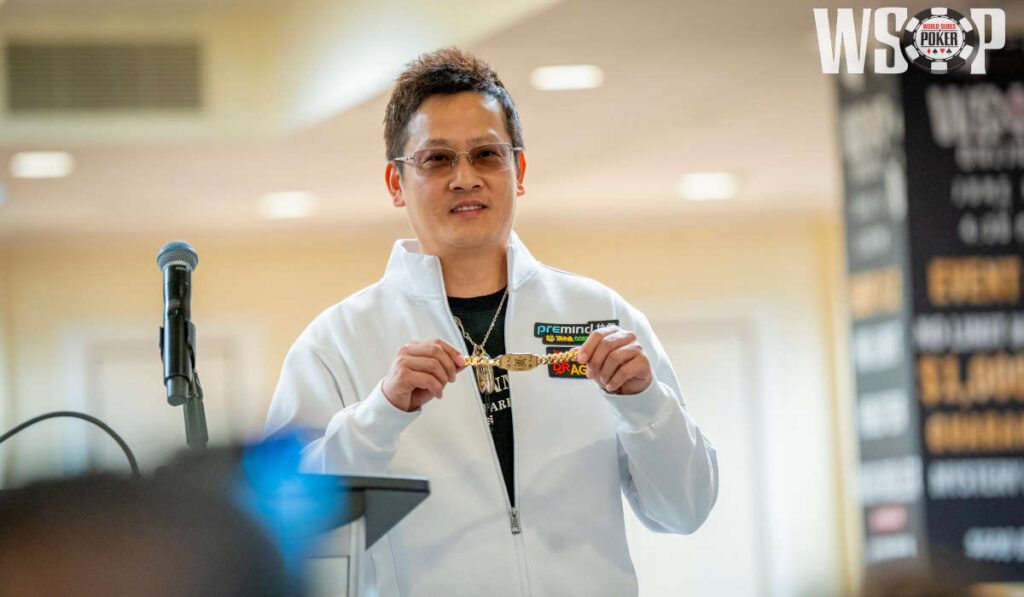
Why? I don’t remember national anthems. Is it the global rise in nationalism? Did they always play them, and I’m forgetting because it’s the most forgettable genre of music after jam bands?
What I guess was a recording of China’s anthem was then played on the rather tinny-sounding loudspeaker system. It was surprising because not only did it sound like Western music, but it was the most generic version of the same, like Pomp and Circumstance meets God Save the Queen played by the brass marching band on game day in Ann Arbor.
All stood out of respect for what is arguably the most powerful nation on the planet; however, the song seemed to go on forever, and several players called the clock. I exaggerate, but is the playing time of a national anthem commensurate with the country’s population? Because that would at least make sense.
“One more time, for Dong Chen,” said Jack when it was finally over. We dutifully clapped, anxious to return to the tournament we were playing.
“And now,” Jack Effel continued, “The winner of Event #29, the $50,000 High Roller, Santhosh Suvarna.” Jack presented Suvarna with his bracelet and spoke with great personal admiration for the player, who then offered his own humble thank you.
“And now, the national anthem of India.” What followed was another poor recording, this one also played by a Western brass band and sounding like something John Phillips Sousa composed, with maybe a hint of Bali-wood musical.
It was shorter than the extended dance mix of Chen’s anthem, but at this point, the whole experience felt like a Chinese water torture.
I guess this is the price we have to pay for the WSOP being a true World Series, as opposed to that phony one that Major League Baseball holds every fall.
The WSOP has players from every country on the planet, and Florida. MLB’s Fall Classic has only American teams, with the exception of the Toronto Blue Jays, though that will be remedied once we annex Canada during the third Trump administration.
Have a great week.