Warning: Undefined array key "post_type_share_twitter_account" in /var/www/vhosts/casinonewsblogger.com/public_html/wp-content/themes/cryptocurrency/vslmd/share/share.php on line 24
Images courtesy of PokerGO Tour
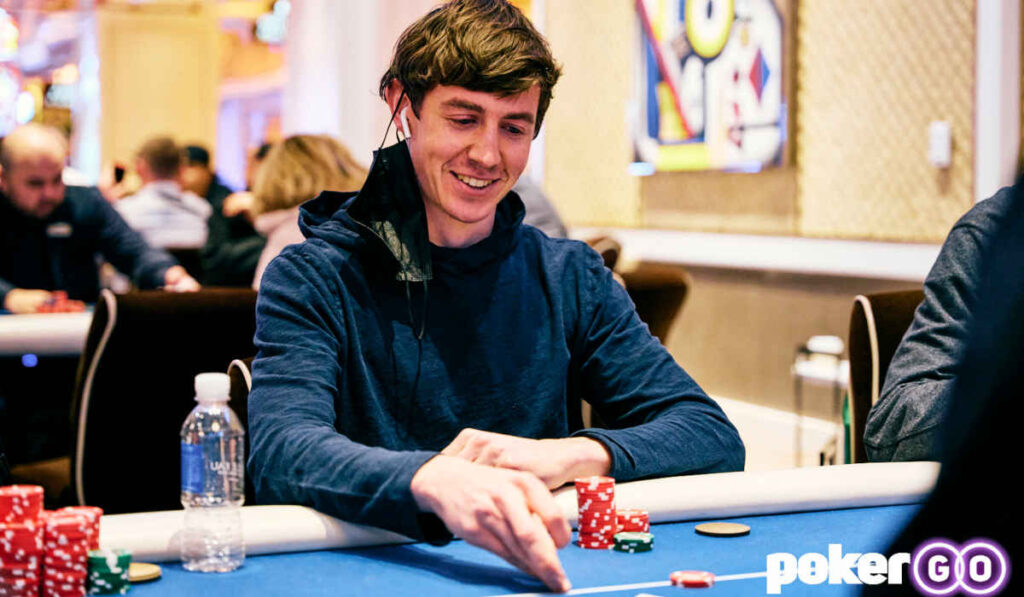
When Brock Wilson closed out the U.S. Poker Open, it wasn’t just another high-stakes win.
It made him the first player to win back-to-back PokerGO major series, following his earlier victory at the PokerGO Cup.
In a game filled with solver-trained players where edges are supposed to be minimal, putting together consecutive series wins really stands out.
That raises a more important question: What actually separates players at the highest level today?
More Than Theory
For Wilson, the biggest shift in his game has not been purely technical. It has been learning how to balance theory with real-world understanding.
“You don’t want to only study theory or only focus on opponent tendencies. A mixture of both is huge,” he explained.
That balance has reshaped how he approaches the game.
Earlier in his career, he often assumed others were thinking through spots the same way he was. “Sometimes I was stuck in my own way of thinking and assumed everyone thought like me. That’s just not the case,” Wilson said.
At the highest level, players are not always acting from clean theoretical frameworks. Many decisions are influenced by discomfort, uncertainty, or a desire to simplify tough spots.
“Some players bet not for a bluff or for value. They’re betting so they don’t have to face a tough decision themselves,” he added.
Understanding those motivations opens up entirely different ways to respond, and those insights rarely come from solvers alone. They come from paying attention and being willing to see the game from different perspectives. That is part of what makes high-level poker less robotic than it looks from the outside.
The Edge Isn’t Where People Think
There is a common belief that everyone at the top level studies relentlessly. Wilson sees it differently. “I don’t think everyone studies as hard as people think,” he said.
In his view, the real edge comes from consistency and mindset rather than access to information.
“I think finding a genuine enjoyment in the process of studying gives you a huge advantage,” Wilson noted. That enjoyment leads to better habits. Instead of relying on random deep dives, progress comes from steady, repeated effort.
“Anybody can find 20 or 30 minutes in their day to look at something. Doing a little bit each day pays dividends,” he said. He also emphasized the importance of pushing beyond comfort zones, even when a play does not feel natural at first.
“Sometimes you see something in a solver simulation, and it doesn’t feel natural. But when you push yourself to do it, you realize it works,” he said.
Even when those plays do not immediately succeed, they can influence how opponents respond in future spots, creating hidden value over time.
“Doing the same spot over and over again, becoming really good at it, and then moving on is a really great way to learn and improve,” Wilson said.
Big Moments Are About Control
High-stakes series come with pressure, variance, and expensive mistakes. Multiple entries, long stretches without cashing, and the reality that even a deep run might barely cover earlier bullets are all part of the format.
Still, Wilson pushes back on the idea that edges are tiny. “The margins aren’t actually that small,” he said.
Instead, the real separation comes from how players handle difficult moments.
“Your job is to lose less than someone else would lose in that spot,” Wilson explained. That perspective shifts the focus away from outcomes and toward decision quality. And when things start going wrong, the next decision becomes critical.
“After bad luck, the next decision you make is where the edge comes from,” he added. Emotional control, in that sense, is not just important. It is one of the biggest edges available.
For Wilson, it comes less from avoiding pain and more from responding to it better than other players do.
Why Adjustments Still Matter
Despite how advanced the game has become, Wilson is clear that poker is far from solved. “Equilibriums are very fragile. If assumptions change even a little, everything changes,” he said.
That fragility creates opportunities. If an opponent is over-folding, the optimal strategy expands quickly.
“It doesn’t matter what your hand is. If they’re folding too much, you just bet more,” Wilson said.
And those tendencies exist even at the highest levels. “There are guys who call too much because they don’t want to get bluffed. Others fold too much when the bets get big,” he explained.
Every player has biases. Every player has patterns. Identifying and adjusting to those tendencies remains one of the most valuable skills in poker. That remains true even when the player pool is filled with elite regulars.
Poker Is Still a Human Game

For all the discussion around solvers and GTO play, Wilson keeps coming back to one core truth. “Emotion creeps into the game at all levels,” he said.
Players react to losses, protect their ego, and avoid uncomfortable decisions. Some become more aggressive after losing a pot, while others shut down. Recognizing those shifts can create a significant advantage.
“Your biggest advantage is being present and paying attention,” Wilson noted.
At the same time, controlling your own reactions is just as important. “The biggest mistake I see is people lose a hand, and then everything falls apart,” he added.
Staying composed while others lose control is a consistent edge, even in the toughest fields.
From Learning to Teaching
Wilson’s work with PokerCoaching.com has reinforced many of these ideas.
Teaching, in particular, has forced him to refine his own thinking. “You have to hold yourself accountable to really understand what you’re saying,” he said.
Explaining concepts often exposes gaps in understanding, while discussions with students introduce new perspectives.
“Sometimes you think you understand something, then you say it out loud and realize you don’t,” Wilson said. That process creates a feedback loop that benefits both the coach and the student.
Brock highlighted that, “Doing a couple of drills per day is really important. Continue to drill the same spot over and over and over again. Become an expert at that spot and then move on.”
If you want to learn more directly from him, Brock just launched a new series on Pokercoaching that covers how to beat the tournaments he’s playing, so make sure to check it out.

Why Most Players Don’t Improve
In today’s game, information is everywhere, but improvement isn’t. “There’s so much information now. It’s easy to get overwhelmed,” Wilson said.
Trying to absorb everything at once often leads to confusion and misapplication. Instead, he emphasizes a slower, more focused approach. This is exactly what he focuses on when coaching others, and implementing structured learning with PokerCoaching and PeakGTO greatly supports this process.
“Poker isn’t going anywhere. You don’t need to learn everything in a day,” he said. Progress comes from narrowing focus and improving specific spots over time.
“Become really good at one spot, then move on to the next,” Wilson added.
He also pointed out that not every strategy needs to be adopted. Different players succeed with different styles. “You have to play a style that’s comfortable for you,” he said.
What This Run Really Shows
Back-to-back PokerGO major titles do not happen by accident.
They are not just the result of variance.
They reflect a system and a repeatable process.
In today’s poker environment, where knowledge is widely available, the edge comes from how well a player applies it, adapts to it, and stays composed under pressure.
Brock Wilson’s run is not just another result.
It is a clear example of what winning at the highest level actually requires today.