Warning: Undefined array key "post_type_share_twitter_account" in /var/www/vhosts/casinonewsblogger.com/public_html/wp-content/themes/cryptocurrency/vslmd/share/share.php on line 24
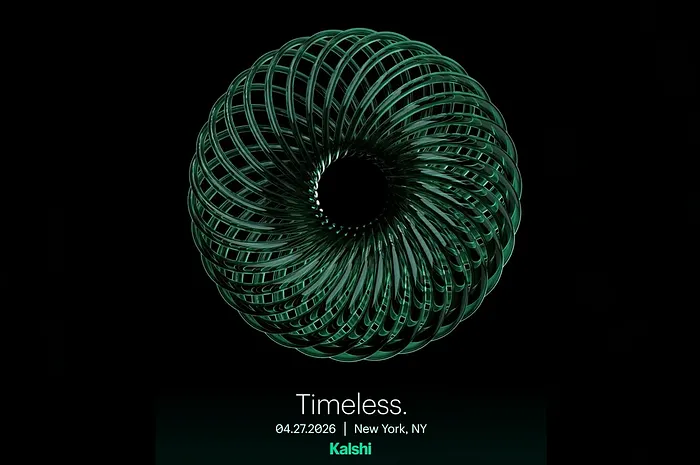
On April 13, Tarek Mansour, co-founder and CEO of Kalshi, posted a cryptic video on LinkedIn. A dark, glassy green torus, an interwoven, looping geometric form, rotates slowly as the camera circles it from different angles. The shot eventually widens, revealing the full object as the word “Timeless” fades in, followed by a date: 4.27.2026, and a location: NY, NYC.
So what is Kalshi teasing? A doomsday cult launch feels unlikely.
Kalshi’s Mysterious New Product Tease
At first glance, the announcement is opaque. But a closer read points fairly clearly in one direction: Perpetual futures.
Perpetual Futures on Kalshi
Perpetual futures, or “perps,” are derivative contracts that allow traders to speculate on price movements, typically in crypto, without owning the underlying asset. Unlike traditional futures, they don’t expire. Positions can remain open indefinitely, with pricing kept in line with the underlying market through a funding rate mechanism. Leverage is standard.
Several clues support this hypothesis. For one, the idea of something “timeless” maps neatly onto a contract with no expiration. Perps are also already dominant in crypto markets, which share a growing overlap, both in users and structure, with prediction markets.
Then there’s the torus itself. The shape isn’t random. A torus, a donut-like form, represents a closed, continuous loop. It is finite in structure but unbounded in flow: a system where motion circulates endlessly without a clear beginning or end. Conceptually, it sits between the finite and the infinite, a useful metaphor for a financial instrument designed to run continuously rather than terminate at a fixed point. That looks less like product signaling to me.
There’s also supporting context. John Wang, Head of Crypto at Kalshi, posted late last August 2025: “Perps are Prediction Markets. Prediction Markets are Perps.”
Why it’s likely Kalshi is launching Perpetual Futures…
- ”Perps” fit the ”timeless” criteria.
- They are already popular in crypto markets, which has significant overlap with prediction markets.
- The torus metaphor, which signifies endlessness – a characteristic of perpetual futures.
- John Wang’s (Head of Crypto at Kalshi) August 2025 post.
The idea, as he laid out in a separate post he linked, is straightforward but ambitious. Instead of traditional fixed-outcome bets, prediction markets could run on perpetual futures rails. Prices would still be anchored by oracles, potentially existing market probabilities, but positions could remain open indefinitely. Liquidity would be shared across markets, and new markets could be created more freely.
The design challenge is risk. Binary outcomes are inherently discontinuous: they can jump from 0 to 100 at resolution. To manage that, the system would likely incorporate safeguards, tightening leverage as resolution approaches, increasing margin requirements for larger positions, and avoiding cascading liquidations by staggering them.
For that reason, scalar markets, like CPI prints or vote share percentages, may be the more natural starting point. They move more smoothly and can support leverage without the same risk of sudden collapse.
What Does this Mean?
If executed well, the model blends two worlds: the speed and capital efficiency of crypto perps with the informational value of prediction markets. The result is something closer to a continuous, globally tradable asset class than a series of one-off bets.
It’s not confirmed, but the signal is strong. If this is where Kalshi is heading, it would mark a meaningful shift – not just for the platform, but for how prediction markets themselves are structured.
Prediction markets involve risk and are not suitable for everyone. While many platforms offer tools to make informed trades, outcomes are never guaranteed, and users should never risk more than they can afford to lose. Always trade responsibly. Additionally, platform availability and legal status vary by region. It is your responsibility to check local laws and verify that you are legally allowed to use a given platform before participating.
Read our full affiliate & risk disclosure.