Warning: Undefined array key "post_type_share_twitter_account" in /var/www/vhosts/casinonewsblogger.com/public_html/wp-content/themes/cryptocurrency/vslmd/share/share.php on line 24
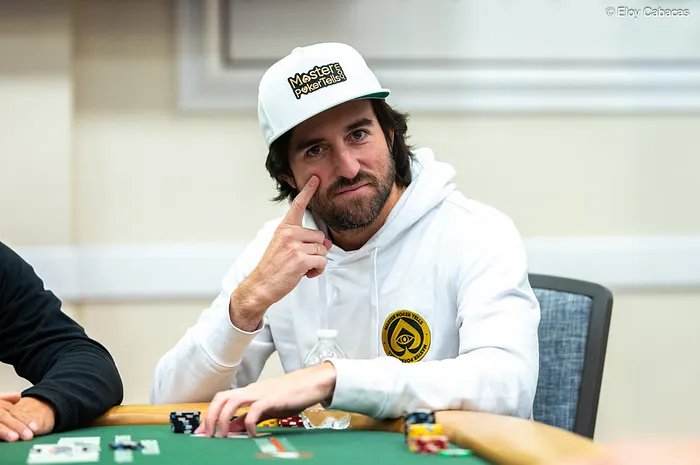
The world of poker strategy has become increasingly solver-driven over the last decade, with players obsessing over balanced ranges, GTO outputs, and technical perfection.
But according to Nacho Cuesta, creator of Master Poker Tells, there’s still a huge part of the game many players are completely overlooking: human behavior.
Cuesta has spent the last five years building what he describes as a structured system for reading live poker tells, breaking down unconscious behaviors into categories including eye movement, betting patterns, verbal cues, and body language. In the process, he says he identified something missing from almost all traditional tells content – structure.
Rather than treating tells as vague anecdotes or poker folklore, Cuesta approaches the subject like a scientific research project, developing a framework built around what he calls “microtells” and “macrotells,” alongside systems for combining signals and weighting reliability.
It sounded interesting, so PokerNews caught up with Cuesta to talk about why he believes tells are more relevant than ever in modern poker, why most tells education misses the mark, and the biggest misconceptions players still have about reading opponents at the table.
The Interview
PokerNews: Nacho, can you tell us a bit about your journey and what led you to create Master Poker Tells? What gaps in poker education were you hoping to fill?
Nacho Cuesta: Poker loves to think it’s solved. It’s not.
What’s actually happened is that the industry became obsessed with solvers and completely neglected the fact that live poker is still played by humans, and humans are leaking information in every single hand.
When I came back to the tables, I saw a massive gap: incredible technical knowledge and almost zero understanding of human behavior.
So I did what nobody else was doing. I treated tells like a serious research problem, not entertainment.
Five years later, I built a system of 74 validated tells, structured into checks, betting actions, eye behavior, verbal patterns, body movement, and all-ins.
And more importantly, I introduced something the industry completely missed: microtells vs macrotells.
Macrotells can be obvious or subtle, but when they hit, they can be decisive. Microtells are not “smaller gestures,” they’re just lower individual weight signals.
And here’s the part most people don’t understand: a cluster of microtells is often stronger than a single macrotell. That’s how you actually read people.
PN: Many people believe that tells are a scam or vastly over-exaggerated. What would you say to those skeptics?
NC: Most tells content is garbage. That’s the truth.
So when people say “tells are a scam,” what they really mean is that they’ve only seen bad tells education.
The idea that humans can sit at a poker table, under pressure, making complex decisions and not leak information? That’s the real myth.
Even elite players leak. Not because they’re bad, but because it’s impossible to control everything.
You’re calculating ranges, thinking about sizings, managing ICM, controlling emotions, and at the same time you’re supposed to control every unconscious movement? Not happening.
That’s where tells live.
PN: Going through the course, one thing that stood out was how structured the approach to tells was. Is that something you felt was missing from traditional poker learning?
NC: Exactly.
Traditional tells content is basically: “Here are some things I’ve seen.” No validation. No structure. No hierarchy.
That doesn’t scale.
What I built is a trainable system with clear categories including checks, bets, eyes, speech, body, and all-ins, alongside reliability weighting, context dependency, and combination logic.
Because here’s the truth: one tell is noise. Multiple tells aligned is information.
And when you combine microtells and macrotells, you move from guessing to narrowing ranges.
PN: After doing the intensive course, I found myself noticing things more when watching poker on TV or playing with friends. Is that a common experience for students?
NC: That’s the most common feedback.
Players don’t just “learn tells,” they upgrade their perception.
Suddenly, everything looks different: bet execution, timing, eye behavior, and small inconsistencies.
And here’s the interesting part: these things were always there. You just weren’t trained to see them.
After that, watching poker without noticing tells feels like watching the game in black and white.
PN: Can you share one tell that players consistently misunderstand or misapply?
NC: Most poker tells you’ve heard are either wrong or incomplete.
Two classics:
1. “Using small chips for a big bet equals bluff.”
No. That’s lazy thinking.
It can mean bluff, but it can also mean strength, depending on habit, comfort, and pattern deviation. Without context, it’s meaningless.
2. “If someone stares at you, they’re weak.”
This one is everywhere, and it’s dangerously wrong.
What matters is not if they look at you. It’s how: blink frequency, eyelid tension, eyebrow position, and stability of the gaze.
A stable, controlled, low-blink stare is often strength.
People oversimplify tells because they want easy answers in a complex game. Poker doesn’t work like that.
PN: Are there any “high-confidence” tells that players can start using immediately at the table?
NC: Yes, there are high-confidence tells, especially in eye behavior and betting patterns.
But if you’re looking for a single tell to base decisions on, you’re already making a mistake.
The real edge is convergence.
When multiple signals, especially microtells, point in the same direction, that’s when you can start making high-confidence adjustments.
That’s how professionals should approach it. Not shortcuts. Systems.
PN: In your view, are tells becoming more or less relevant in modern poker, especially with the rise of online play and solver-influenced strategy?
NC: This is the paradox nobody talks about.
Poker strategy is at its highest level ever. But that comes with a cost: cognitive overload.
The more complex the decisions, the more your brain is occupied and the less control you have over unconscious behavior.
So no, tells are not disappearing. They’re becoming more valuable. Because everyone studies the same ranges, but almost nobody studies human behavior properly.
That’s where the next edge is.
PN: Thanks for your time, Nacho. Great to catch up!

Editor, Poker & Casino