Warning: Undefined array key "post_type_share_twitter_account" in /var/www/vhosts/casinonewsblogger.com/public_html/wp-content/themes/cryptocurrency/vslmd/share/share.php on line 24
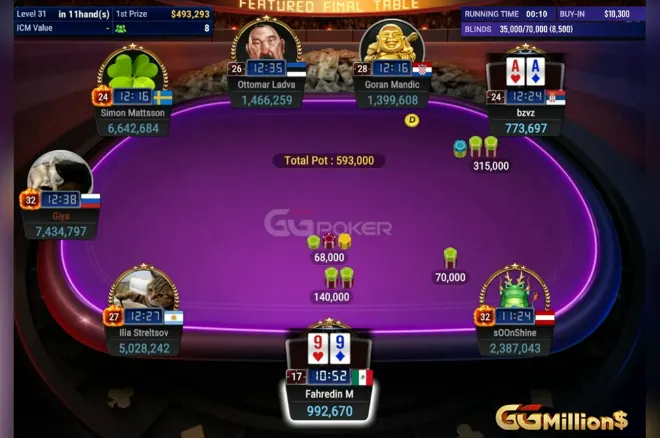
Folding pocket nines at a final table rarely feels comfortable, especially when stacks are shallow and pay jumps are looming. But in high-pressure ICM spots, even strong hands can become marginal.
WPT Global streamer Lukas “RobinPoker” Robinson used GTO Wizard to analyse a tricky preflop decision from a 2026 $10,300 GGMillion$ Final Table, where Fahredin Mustafov opened with pocket nines and faced a three-bet from the small blind.
The hand raised several key questions. Was the three-bet sizing correct? Should pocket nines ever fold here? And what changes if the small blind moves all-in instead?
The Hand
The hand took place eight-handed at the GGMillion$ Final Table, with blinds at 35,000/70,000 and $493,294 awaiting the winner. Several players were sitting on short stacks between 15 and 21 big blinds, creating enormous ICM pressure across the table.
Stack Sizes and Positions
| Player | Position | Chips | Big Blinds |
|---|---|---|---|
| Fahredin M | UTG | 1,132,670 | 16.2bb |
| Ilia Streltsov | UTG+1 | 5,028,242 | 71.8bb |
| Giya | LJ | 7,434,797 | 106.2bb |
| Simon Mattsson | HJ | 6,642,684 | 94.9bb |
| Ottomar Ladva | CO | 1,466,259 | 20.9bb |
| Goran Mandic | BTN | 1,399,608 | 20.0bb |
| bzvz | SB | 1,053,697 | 15.1bb |
| s00nShine | BB | 2,387,043 | 34.1bb |
Mustafov opened the action from under the gun with 16.2 big blinds, while “bzvz” sat in the small blind with just over 15 big blinds.
With multiple short stacks and large pay jumps still to come, every decision carried significant tournament equity implications.
GGMillion$ Final Table Payouts
| Place | Prize |
|---|---|
| 1 | $493,294 |
| 2 | $380,381 |
| 3 | $293,314 |
| 4 | $226,176 |
| 5 | $174,406 |
| 6 | $134,485 |
| 7 | $103,702 |
| 8 | $79,965 |
Mustafov opened to 140,000 from under the gun holding 9♥9♦. From the small blind, “bzvz” responded with a three-bet to 315,000 holding A♥A♦.
After taking time to consider his options, Mustafov elected to fold pocket nines. While the fold may seem cautious at first glance, solver analysis reveals the situation is far more nuanced.
Pre-Flop Analysis
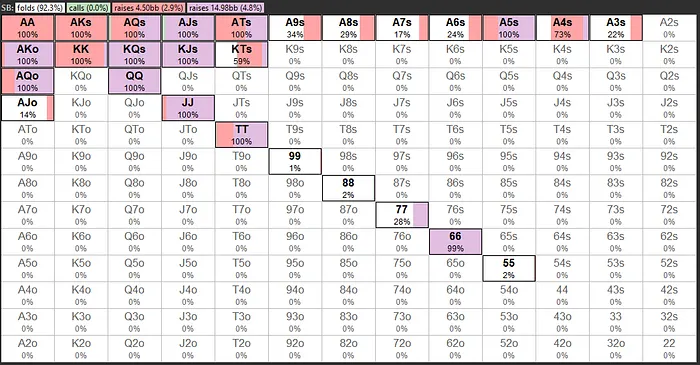
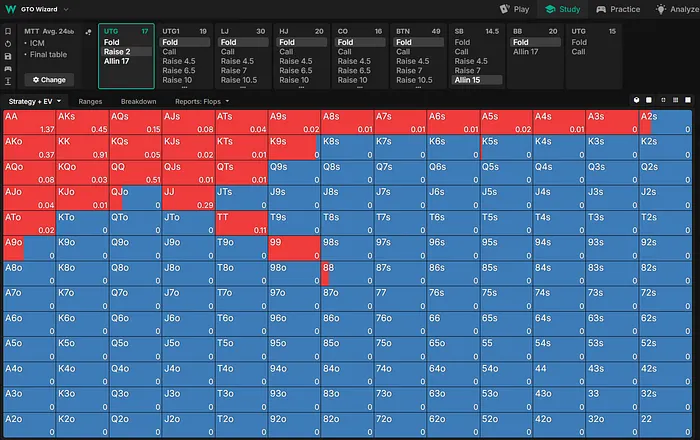
Mustafov’s open with pocket nines is solver-approved. In fact, pocket nines represent the lowest pocket pair that is opened purely from UTG in this configuration.
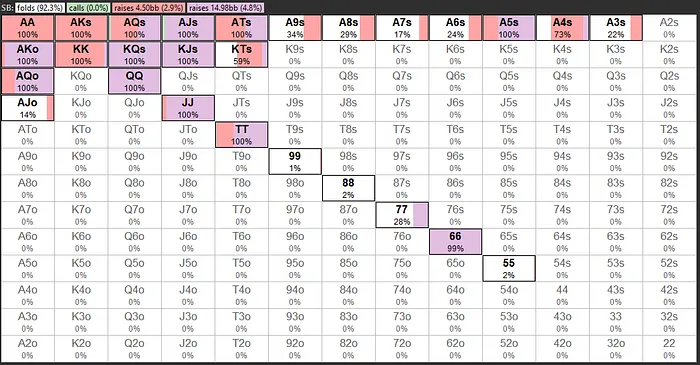
The focus quickly shifts to the small blind’s response.
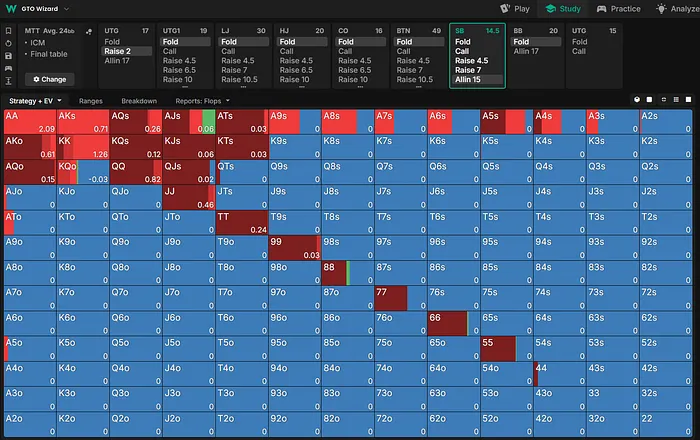
“Bzvz”’s three-bet with aces to 315,000 is also solver-approved, and more importantly, the sizing is nearly perfect.
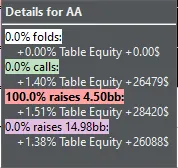
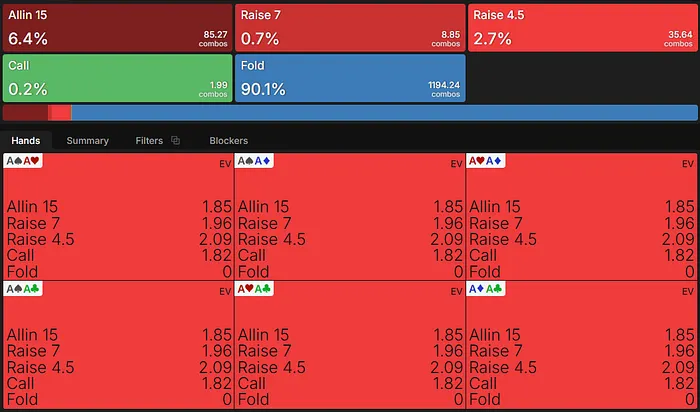
The solver consistently prefers a 4.5 big blind three-bet size with aces in this configuration, generating the highest $EV overall (expected value).
To confirm the consistency of this poker strategy, a similar GGMillion$ final-table simulation was run using GTO Wizard. Despite slight differences in stack depth, the solver once again favoured the 4.5 big blind sizing with pocket aces.
Was the Three-Bet Size Correct?
This answers the first key question: Was the Three-bet sizing correct?
Yes. The 4.5bb sizing used by “bzvz” is the most optimal choice overall, outperforming an immediate all-in in terms of expected value.
Should Pocket Nines Fold to This Three-Bet?
The next question focuses on Mustafov’s decision.
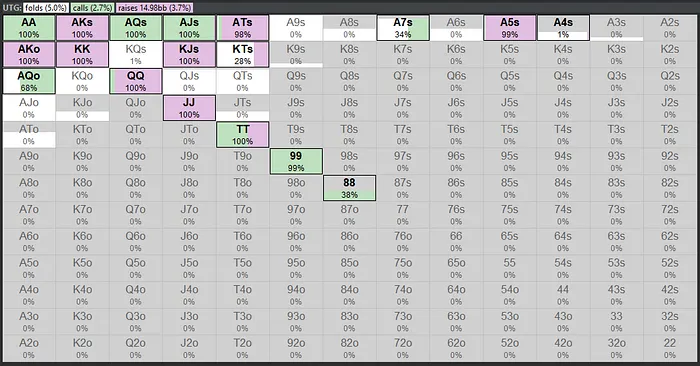
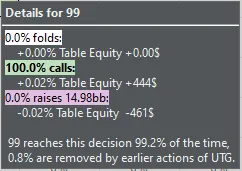
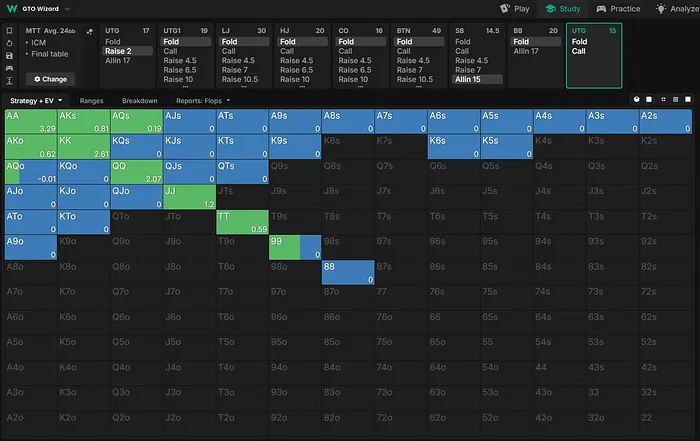
Facing the 4.5 big blind three-bet, the solver strongly prefers continuing with pocket nines rather than folding.
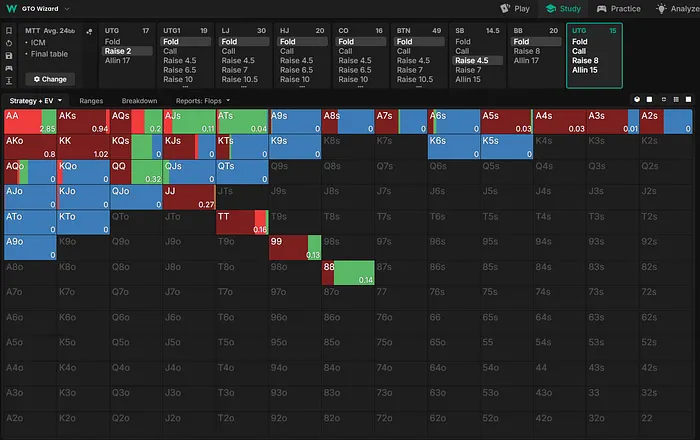
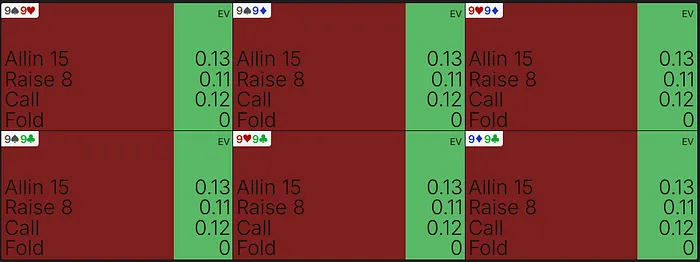
Using both GTO Wizard and ICM modelling software, pocket nines are shown to generate higher EV when played aggressively. In some simulations, the solver recommends a pure call, while in others it mixes between calling and shoving all-in.
In neither simulation does pocket nines fold.
That means Mustafov’s fold — while understandable under pressure — is technically a theoretical mistake.
Pocket nines remain strong enough to continue against this sizing, even under heavy ICM pressure.
What If the Small Blind Jammed Instead?
The final question explores an alternate scenario.
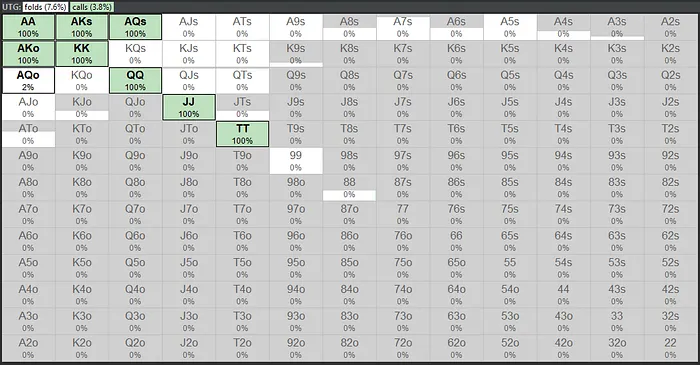
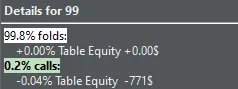
If “bzvz” had moved all-in instead of using the 4.5 big blind three-bet sizing, the solver’s recommendation changes dramatically.
Against an all-in three-bet, pocket nines becomes a fold at very high frequency. Both solver outputs show that calling loses EV in this situation, meaning folding would be the correct theoretical response.
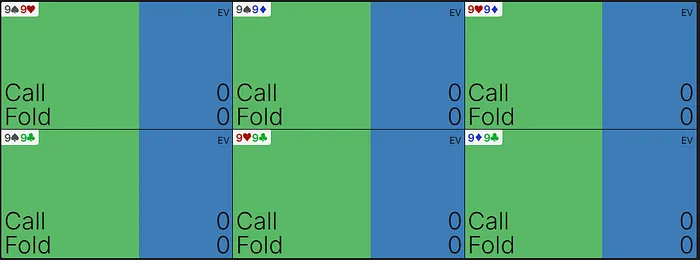
In other words, the difference between a small three-bet and an all-in dramatically changes the optimal strategy.
That distinction highlights just how important bet sizing becomes in final-table environments.
Why This Spot Matters
This hand perfectly illustrates how subtle differences in sizing can shift optimal decisions at a final table.
A 4.5 big blind three-bet with aces generates more value than jamming immediately, while also forcing opponents into difficult decisions with medium-strength hands like pocket nines.
For Mustafov, the fold was understandable given the risk of elimination. However, solver outputs show that continuing — either by calling or shoving — would have been more profitable in theory.
Final Verdict
So, was folding pocket nines the correct play?
Against the exact 4.5 big blind three-bet sizing used in-game, the answer is no. Pocket nines should continue rather than fold.
However, had the small blind moved all-in instead, folding would have been the correct play.
This hand highlights one of the most important lessons in tournament poker: bet sizing shapes decisions. Even with the same cards, changing the size of a three-bet can completely alter the correct strategy.
For players looking to improve their final-table decisions, tools like GTO Wizard make it possible to explore these scenarios in detail and understand how small adjustments create large EV swings.

WPT Global Streamer