Warning: Undefined array key "post_type_share_twitter_account" in /var/www/vhosts/casinonewsblogger.com/public_html/wp-content/themes/cryptocurrency/vslmd/share/share.php on line 24
Image courtesy of the World Poker Tour
There is one big mistake that players new to the game continue to make, both live and online, and this blunder, if not fixed, will make it impossible to win.
That mistake is limping before the flop when they are first to act.
To succeed in poker, you need to focus on preflop play, first and foremost. However, this is often tricky for new players, because it doesn’t feel that difficult or important.
However, you make preflop decisions every single hand, and suboptimal preflop decisions will result in bad postflop play. If you start with ranges that are too wide and too weak, it will be very difficult to have a positive win rate.
Do Not Limp In
As most of you know, limping in poker is just calling the big blind, and you need to stop doing this, especially when you’re the first person to enter the pot. Your only options are folding or raising.
Just calling a big blind is not a viable option. You have to stop trying to trick your opponents with hands like pocket aces or attempting to see cheap flops with small pairs.
There are a couple of reasons why this doesn’t work.
First of all, you are going to have a tough time playing a big pot when you do make a hand, because the pot is small to begin with, as there were no raises.
Secondly, in cash games, you’re guaranteed to pay the rake. If you raise, you can win the pot right then and there, not having to pay the rake, or, if they call, the pot will grow to the point where the rake is getting close to the capped amount.
Let’s now break this topic further down by introducing three specific reasons why you should never limp.
#1 Limping Telegraphs Weakness
Most players will see a limp as weak because there are a lot of marginal hand combinations that you could reasonably have when you go for this option.
This includes small pairs, suited connectors, some weaker suited aces and kings, etc. At the same time, you’re not limping in with your best hands, like pocket aces, kings, queens, or ace king.
So, limping in puts a target on your back. You’re splitting your range early in the hand, allowing your opponents to raise with their strong holdings and limp behind with weaker hands that they want to take to the flop.
If you raise or fold with your entire range instead, you deny them this knowledge.
Some players may say that they balance it by limping with aces and kings on occasion as well. While this may work to some extent, it’s not really what you want to be doing, as you want to play big pots with your best hands, and the best way to build pots is by raising.
#2 It Takes Away Your Initiative
When you open limp, you don’t take control of the hand, making it harder to win after the flop unless you make the best hand.
If you raise with a hand like 56s and the flop comes AKQ, you can fire a continuation bet, and your opponent(s) will fold when they don’t connect. You don’t have this option when you’re not the preflop aggressor.
When you have the initiative, you can also barrel on different turns and win pots through pure aggression, even in scenarios where you know you don’t have the best hand.
Limping also takes away your basic preflop fold equity. When you raise, there is always a chance everyone folds, and you win the pot uncontested, which is actually a great result for the bottom portion of your opening range, i.e., hands like 56s.
#3 Limping Leads to More Multiway Pots
Finally, limping leads to more multiway situations, where you are forced to make a decent hand in order to win the pot. While multiway spots are somewhat unavoidable in small stakes games, you need to have a strong, uncapped raising range that you play as a raise or fold.
If you constantly limp and play multiway pots with marginal hands, you’ll be winnings small and losing big pots. These are very difficult spots to navigate, as most of the time, someone will have a strong hand.
You’ll also realize that the idea of limping to see a cheap flop and make a good hand doesn’t really work against even semi-competent players. Your opponents will be far less inclined to fight hard in multiway scenarios because they are aware that someone is likely to have a strong hand and will often relinquish their medium-strength holdings.
GTO Opening Ranges
To wrap this up, let’s look at a couple of RFI (raise first in) charts. The picture below shows your range from the lojack, which will be first to act in a six-max game.
As you can see, you only get to raise with about 15% of the hands, which may seem very tight, because players at small stakes often raise all sorts of junk, basically torching money on fire.
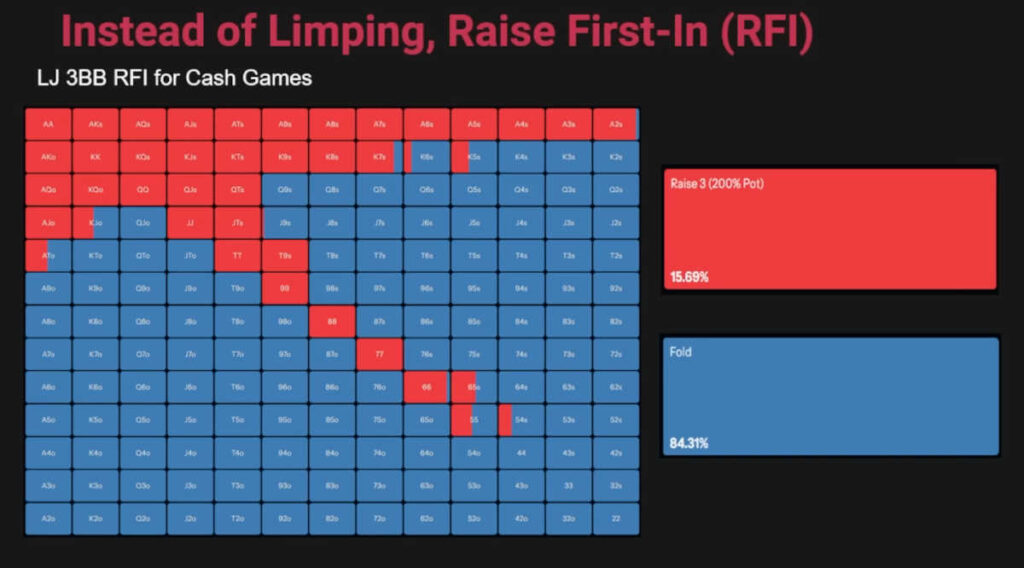
Some players, though, instead of raising, will limp in with some marginal hands, like the smallest pocket pairs, hands like T8s, 86s, A9o, etc. This makes their limping range very weak and prone to getting exploited.
On the button, we get to raise with about 40%, and if the blinds are weak, we can go even wider. However, no matter what, you should not be limping from this position.
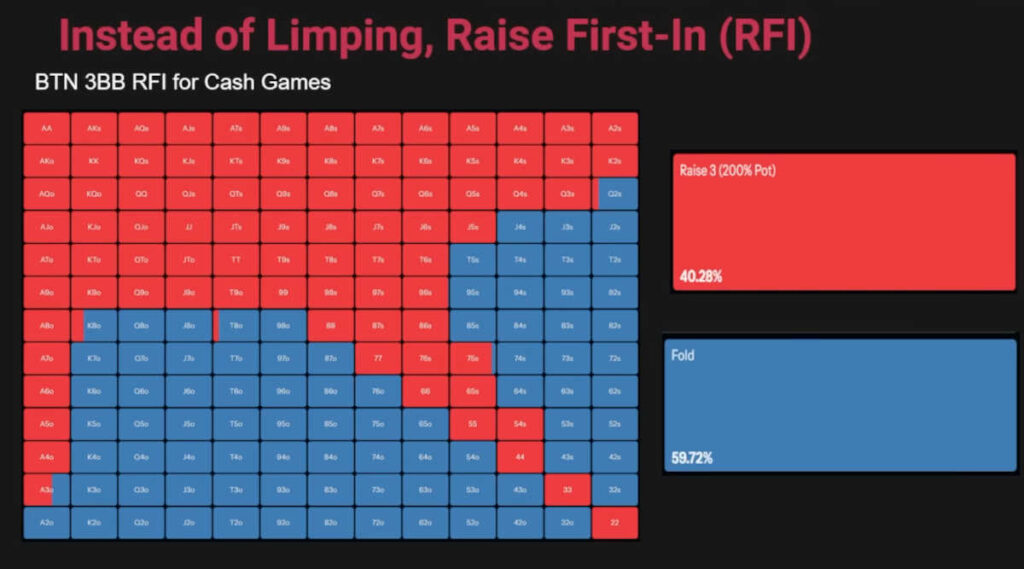
You’ll exploit your tight and passive opponents by raising, not limping with all sorts of weak hands in hopes of smashing the flop. From the button, you can win a lot of pots by raising with some fairly weak hands, and that’s an excellent result.
To sum it up, stop leaking chips by limping. It telegraphs weakness, takes away initiative, and leads to multiway pots. Focus on playing a strong PFR strategy that builds pots with your best pots, gains fold equity, isolates blinds, and allows you to control your own fate instead of hoping to flop the nuts seven ways!