Warning: Undefined array key "post_type_share_twitter_account" in /var/www/vhosts/casinonewsblogger.com/public_html/wp-content/themes/cryptocurrency/vslmd/share/share.php on line 24
Televised cash games have evolved over the years, and we have probably seen more seven-figure pots played on TV in the last few years than we had in the earlier decade, thanks in part to shows like High Stakes Poker and No Gamble No Future.
One particular No Gamble No Future game, played in early 2023, gave us some of the most memorable moments and biggest pots in TV poker history, including the iconic hand played between Eric Persson and Partik Antonius.
This hand was the ultimate showdown between a highly respected poker shark who rarely makes any comments during poker hands and a trash-talking whale, in too deep for his own good.
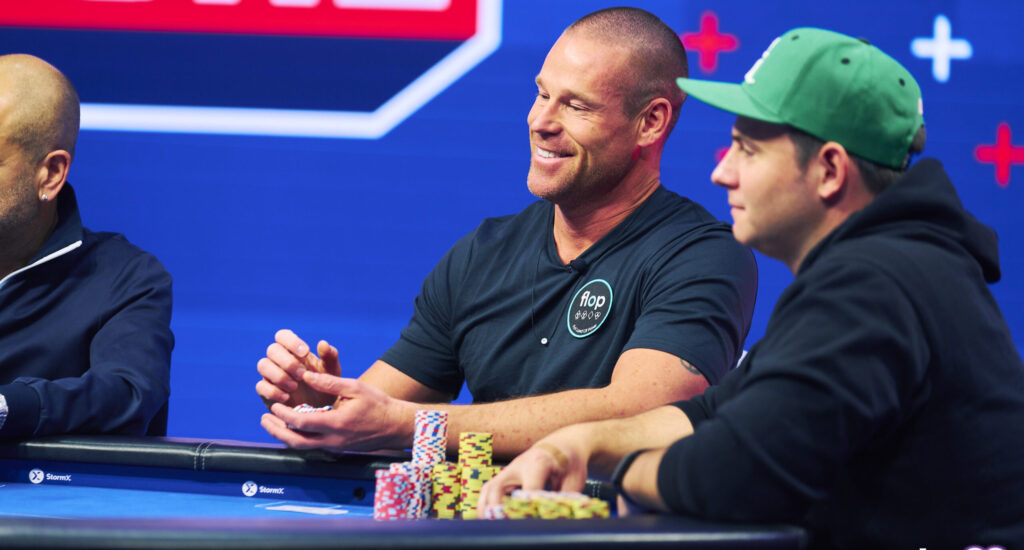
Antonius Takes Persson to School
For the first time in its history, No Gamble No Future hosted a million-dollar game in early 2023, and the table was stacked with high-stakes pros like the online poker legend Andrew Robl, Partik Antonius, and Markus Gonsalves.
To balance things out, the show brought in a few recreational players with deep pockets, including Rob Yong and Eric Persson, both of whom were eager to match up with the pros.
By far the biggest pot of the entire game came down to Patrik and Antonius, who had been exchanging some friendly banter leading up to the hand, mostly driven by Persson’s incessant need to keep talking, whether he’s in a hand or not.
With the blinds at $1k/$2k, Persson made a raise to $7k holding Q♥9♥, a fairly standard play in a short-handed game. Rob Yond made the call with A♣2♣ from the button, before Patrik Antonius looked down at A♥K♥ in the small blind.
Always one to take the aggressive line, Antonius made it $30k to go, and this was Persson’s chance to get out. However, he decided to take the stoic Finn on, alluding to Patrik’s lack of positional advantage as he made the call.
Yong joined them, and the flop brought 9♥3♣3♥, giving both players a flush draw, and bricking Yong for the most part.
Patrik made a standard $40k c-bet, and Eric raised it up to $140k almost instantly, a play that had no clear plan behind it. Patrik recognized that a lot of Eric’s range would be weaker flush draws, so he put in another raise to $250k, trying to get value from his opponent right away.
Eric obliged with his Queen-high flush draw, and the turn brought the A♠, locking the hand up for Antonius.
Patrik now down-bet to $150k, looking to squeeze further value from Persson, and instead of calling to try to realize his equity, Persson now moved all-in for nearly $700k in total.
The line made nearly no sense, as Persson was representing exclusively a hand like A3 or 43, which was possible but not highly likely. Instead, he had exactly what made the most sense, a flush draw that was now drawing dead.
To showcase just how out of his depth Eric actually was, the viewers got to hear him say “a Queen or a Nine” out loud, thinking he could still win the pot if a Queen or a Nine hit the river, oblivious of the fact Patrik had a pair of Aces and a complete lock on the hand.
Just like that, in a matter of about two minutes, Eric Persson lost one of the biggest pots in TV poker history, which could have been significantly smaller had he not tried to bully Antonius on every single street.
What could have been a preflop fold, or a loss of about $150k, had he just called Patrik’s bets, ended up costing Eric a million dollars, showing once again that relentless aggression isn’t always the solution in a poker game.
Persson Becomes One of Poker’s Biggest Losers
When he first started showing up in televised poker games, Eric Persson made it sound like he was one of the best and scariest players you could have at your table.
Big bets, relentless trash talking, and a whole lot of “alpha male energy” were his trademarks, as he made sure he was always the loudest one at every table he played at.
Yet, despite all his words and bravado, one thing that was clear from the get-go was that Persson simply didn’t know how to play poker all that well.
His lines were erratic, his bet sizing was all over the place, and even his speech play often revealed more about the strength of his own hand than anything else.
On more than one occasion, Persson turned his cards over out of turn in big pots, and his entire game plan often came down to getting hit by the deck, rather than making reasonable plays with the cards he was dealt.
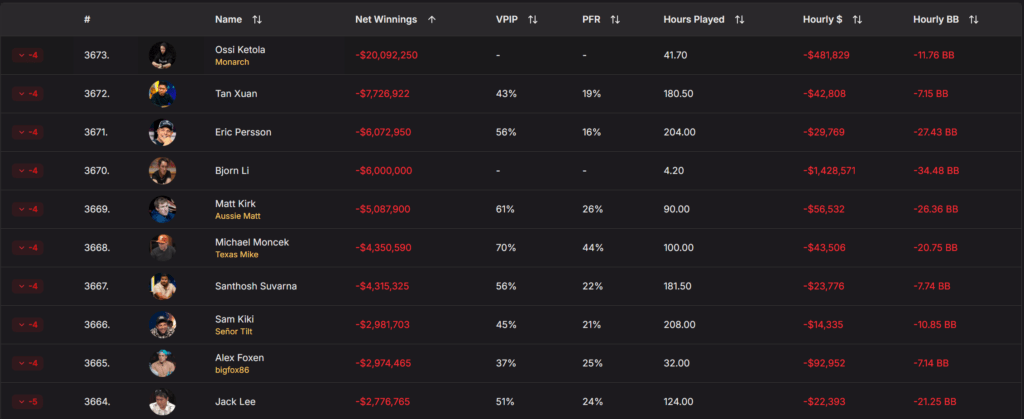
Early on, Persson had a few good sessions, which boosted his ego even more, but after playing just 200 hours on high-stakes poker shows, he was down around $6,000,000.
In fact, according to the highly accurate Highroll Poker database, only two players have lost more money playing poker on TV to date than Eric Persson. Those two are the Asian high roller Tan Xuan, who played in some extremely high-stakes games, and Ossi Ketola, whose losses came from a series of multi-million heads-up matches.
Besides those two, Persson was able to quickly burn through more money than the likes of Santhosh Suvarna, Texas Mike, or Matt Kirk, all of whom have been the big losers over similar hand samples.
Persson disappeared from the high-stakes poker scene after incurring these losses, perhaps after realizing he was the whale in a pond full of sharks.
A Major Lesson in Bankroll Management and Ego Control
Poker is a game of numbers and balance, where every decision impacts your bottom line. Proper bankroll management and emotional control are just as important as mathematical skills, and Eric Persson is a great example of a player who forgot all about these important factors.
From the start, Persson was facing an impossible challenge of playing against some of the brightest poker minds around. What’s even worse, he took the worst possible approach to that challenge, looking to outsmart and bully players with decades of experience in high-stakes poker games.
His “stance” against Patrik Antonius was just the biggest example of Persson’s ego getting the best of him, adding to his overall demise on the high-stakes poker scene.
While he would hardly ever admit it, Persson was outclassed at every turn, and instead of admitting it and looking to improve his game, his response was to keep coming back and blasting away for even higher stakes.
While few of us will ever find ourselves playing in games as high as these, the lesson works at every stake and in every game. If you find yourself losing regularly, take a step back, re-evaluate your game, and leave room for the possibility that you are simply getting outplayed.