Warning: Undefined array key "post_type_share_twitter_account" in /var/www/vhosts/casinonewsblogger.com/public_html/wp-content/themes/cryptocurrency/vslmd/share/share.php on line 24
Image courtesy of World Poker Tour
While there are many players out there who are winning at the tables, there are many more who are struggling.
If you happen to be in the latter group, and don’t quite know why that might be the case, it’s probably not just bad luck you’re dealing with.
For most players who can’t manage to win consistently, there are very specific reasons as to why. In this article, I’ll address three of the most common ones. This is not meant as criticism in any way, but rather as helpful and educational advice to help you improve and get on the winning path.
You Care Way Too Much About Your Hand, and Too Little About the Range
Many players look at their hole cards, and the only thing they think about is: how do I play my hand? However, you need to understand that any time you’re making a decision at the table, you are splitting your range.
Say that everyone folds to you on the button. You raise with your solid hands and fold the bad ones. But what happens if you, as some players do, limp every time with your medium-strength hands?
In the simplest of terms, this will make your limping range very marginal, which means that the observing opponents will be able to apply aggression and force you to fold more often than not, be it on the flop, the turn, or the river.
So, to prevent this, you want to make sure that you have a balanced range that is difficult to play against.
For example, we raise with all the hands that are not marked in white on the chart below (that’s our preflop range on the button), and the big blind calls. The flop comes 10♦8♣6♥.
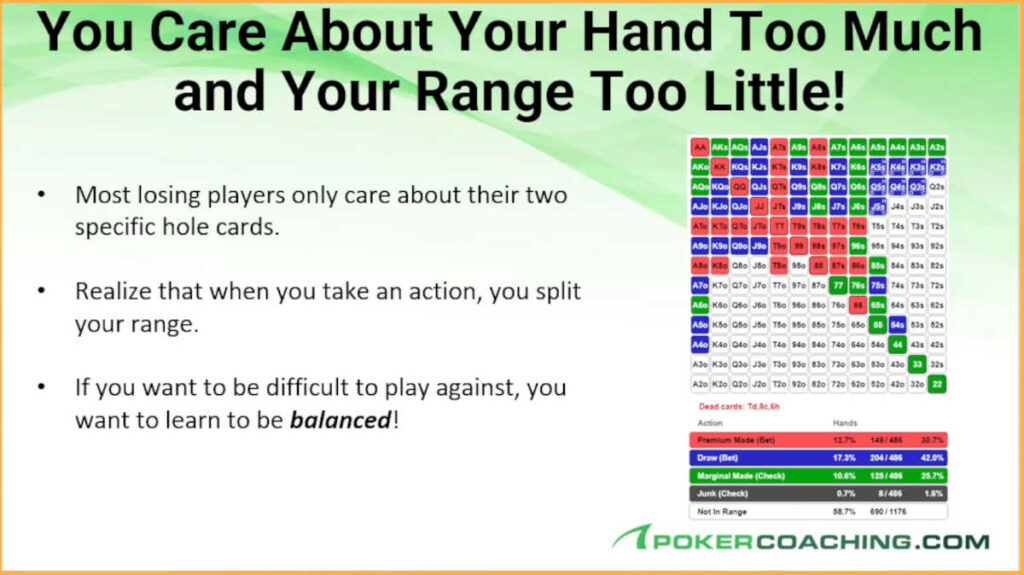
At this point, we need to know what we are doing with our entire range. We are betting some of it, and checking back some of it, but it is important that we have a mix of strong and weak hands in both of those sections.
Generally speaking, in a situation where we have a big range advantage, we want to bet frequently. This is not the case on this particular flop, as the caller will have many strong hands.
So, we first categorize our hand. Is it a premium, a draw, a marginal hand, or junk? After that, in the situation where we don’t have the range advantage, we’ll bet with our premium holdings and our draws.
Our draws consist of a mix of good draws (like open-enders and gutshots with overcards) and bad ones, like backdoor flush draws (like K♥2♥). With good draws, we can bet and call if we get raised; with bad draws, we’ll bet and fold to aggression.
But what about our checking range? This is where many players go wrong.
They’ll default to betting every pair, which makes their checking range only ace-high or worse. If you do it on this flop, unless you hit an ace on the turn, you’ll have to fold to every bet. And, if your opponent is satisfied to check it down, they probably have a pair already, beating your ace-high.
Therefore, you want to make sure to put some hands into your checking range that won’t have to fold to a turn bet, i.e., some 8s, some 6s, and you can even check back aces sometimes.
Game Selection: Playing in Tough Games
People will often play as high as they possibly can, to the point of failure. Winning players usually play a level or two below what they could conceivably play.
The logic here is quite simple. If you’re the ninth-best poker player in the whole world, but you only ever play against the top eight players in the world, you will lose in the long run.
There are some $10,000 tournaments out there that are quite soft because they have many players coming through cheap satellites. And then, there are some very tough $10,000 events that have very few or no satellite qualifiers, so the average level of play is much higher.
If you care about having an edge, you want to make sure you’re playing in the softest games possible. In tough games, your ROI might be just 5%-10%, while in the soft ones, it could go as high as 50%.
And this applies to cash games, too. Even if you’re playing $1/$3, some games won’t be particularly good, as rake will usually be quite high, and there will be tables where players are just taking the game very seriously.
This is not the kind of game that you want to play in. Instead, you want to find a table where everyone is having a good time and splashing around.
Additionally, in games like No Limit Texas Hold’em and PLO, chips tend to flow from right to left. Thus, if possible, you want to have big stacks to your right and small ones to your left. That way, you’ll be able to win more big pots and, when you lose, you’ll often lose in smaller pots.
You Are Far Too Emotional About Short Term Variance
Poker is a high-variance game, and if you look at it as some kind of get-rich-quick scheme, you’re just not going to make it.
While there are instances every year of someone going on a heater and winning a bunch of money by parlaying their winnings, there are many, many more players who go broke by trying this.
If you’re playing with a small bankroll and taking huge shots, especially in tough games as buy-ins get higher, your edge diminishes. At that point, you’re pretty much flipping a coin, even if you have a very small edge.

Many people, especially in live poker, also don’t play enough. Volume cures variance. You have to work hard and play a lot to realize your edge. It may feel like everyone is just winning all the time, but that’s because these are the stories that the media focuses on. It’s not the reality.
No matter what, you won’t always go out and crush your opponents. You need to understand how variance works in poker. But if you play with an edge and put in enough volume, it’s impossible to lose in the long run.
However, the long run is longer than what most people imagine, and prolonged losing streaks can lead to frustration and tilt.
This can have a compounded effect, as you’ll turn up to play already annoyed and tilted, causing you not to play well and putting you at a big disadvantage.
To avoid this, it’s important to put things in perspective. If you get to play poker, you’re probably doing fairly well in life. The game is supposed to be fun and enjoyable, and an easy way to make it that way is to win. So, don’t go on tilt over short-term results; accept that variance exists and realize that, as long as you have the bankroll and put in the volume, you will overcome it!