Warning: Undefined array key "post_type_share_twitter_account" in /var/www/vhosts/casinonewsblogger.com/public_html/wp-content/themes/cryptocurrency/vslmd/share/share.php on line 24
Image courtesy of World Poker Tour
In poker, you have to make preflop decisions every single hand. This means that, if your preflop game isn’t good, it will cost you a lot of money in the long run.
Even the smallest of mistakes, if you make them consistently, will result in you spewing heaps of money to your opponents. And that’s exactly the opposite of what you need to do to win in poker.
So, in this article, I will highlight three tips to help you improve your play and start crushing low stakes. The focus will be on 100 big blind deep, six-handed cash games.
Tip #1: Always Raise First In
One simple tip that can significantly improve your results is that you should always raise or fold before the flop when the action folds to you.
Do not ever just call the big blind.
By not raising, you’re allowing other players to see the flop cheaply, and you’re letting the big blind in for free, allowing them to realize their equity with a variety of marginal hands that they would have to fold facing a raise.
Often, people justify limping in by saying their hand wasn’t good enough to raise with. But if the hand is not strong enough to raise with, then you should just fold it. Calling is not an answer.
Let’s look at our preflop strategy from the lojack position at a six-max table (first to act before the flop).
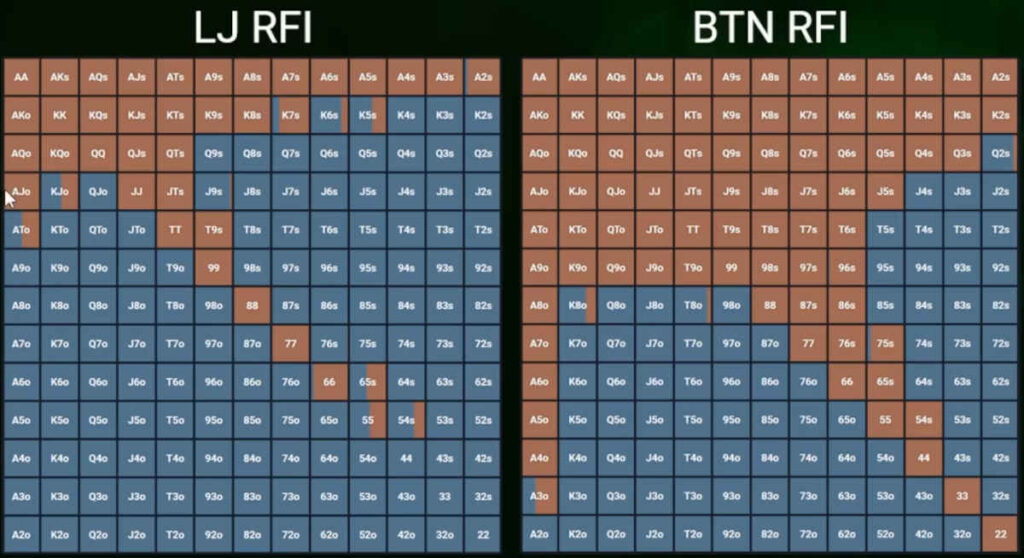
In this spot, we are raising with any suited ace, all suited broadways, K7s+, KJo+, 55+, and some weaker hands like T9s and 54s. Everything else, we should be folding.
Hands such as KTo, QJo, Q9s, 96s, 76s, etc., are simply not strong enough to play from this position. Instead of trying to sneak to the flop by calling and hoping for the best, simply fold.
The above strategy presumes that everybody plays perfectly, which is usually not the case at lower stakes, which means that you can slightly widen your raising range. A good way to do this is by raising 100% with hands that are supposed to raise at a lower frequency.
On the button, as you can see on the second chart, our raising range is much wider, but there are still quite a few hands that we should be folding.
The bottom line is, stick to the raise or fold strategy. The only time when limping makes sense is when you’re in the small blind, but that’s an entirely different topic of its own, which we won’t cover in this particular article.
Tip #2: Stop Calling Raises With Weak Hands
When a player raises, that’s usually an indication that they have a strong or at least a solid hand. Plus, all other players still to act can wake up with a strong hand, as we have no information about the opponents behind.
This means that, facing a raise, we can only continue with solid holdings ourselves. This means premium hands and hands with a decent possibility to improve to beat premiums, such as suited aces, pairs, and some suited connectors.
Let’s check out GTO charts once more, looking at the hijack range facing a lojack open.
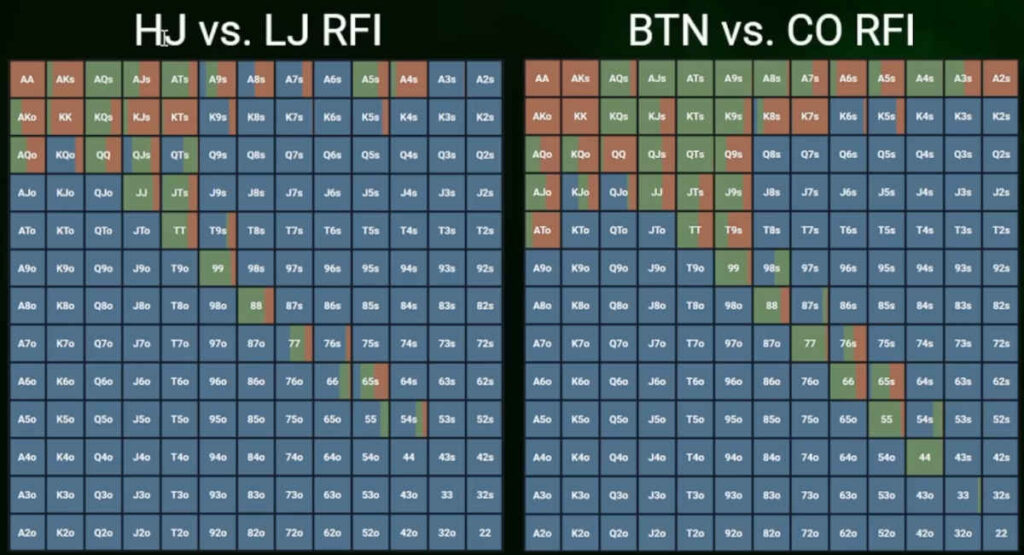
You can see on the first chart that we are folding a ton here – even hands as strong as AJo, KQo, many suited aces, and the smallest of pocket pairs. We are continuing with a selection of suited aces, pocket sixes and better, and AQo+.
You can’t afford to call with hands like Q8s, KJo, 98o, etc. If you constantly do this, you’ll get crushed, as there are still players who have position on you, plus players in the blinds can 3-bet. So, by calling with these holdings, you’re constantly leaking a little bit of money to your opponents.
Looking at the second chart, button vs. cutoff, we get to play all suited aces, pocket fours and better, K7s, KJo, QJo, and some suited connectors. However, we are still folding a lot. Hands like A9o, JTo, 98o, etc., you need to simply let go.
You can’t afford to be too loose calling raises. If you constantly call with weak hands, facing opponents who study the game and know what they’re doing, who do you think will come on top in the long run?
Tips #3: 3-Bet a Polarized Range in Position
One common mistake that many players make at low stakes is that they re-raise (3-bet) only with their strongest hands.
This makes them very easy to play against. When they 3-bet, their opponents know they’re up against a strong range. Conversely, if they just call, they are making it clear that they aren’t holding a premium starting hand.
To avoid being too predictable and make it harder on your opponents, you need to 3-bet with a polarized range instead. This means re-raising your absolutely best hands and hands that are not quite good enough to call.
This allows you to flat call with what’s called a condensed range, i.e., all the hand combinations that you’re happy to see the flop with and take it from there.
For example, let’s look at the strategy for the hijack position facing a lojack raise.
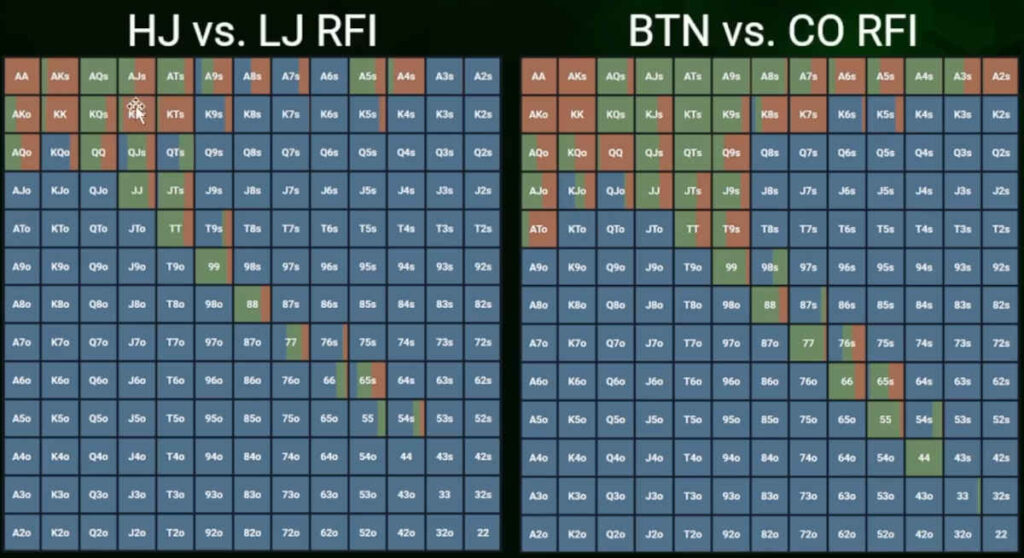
We are 3-betting QQ+, AK, a selection of suited aces and kings, a few small pairs, some suited connectors, and hands like AQo and KQo at some frequency. In this setup, the only really strong hands are aces, kings, queens, and ace-king. Everything else we can pretty much treat as bluffs at 100 big blinds deep.
Hands that are happy to just call and see the flop are largely strong broadways and pocket pairs.
Another mistake that people make here is that they will 3-bet too wide, i.e., 88+, ATs+, which makes their 3-betting range too strong, and doesn’t leave enough good holdings in their calling range.
You need to tailor your strategy so that it allows your opponents to make mistakes. If you make it easy for them to play well against you, you won’t make any money off of them.
As a bonus tip at the end of this article, you should study poker a lot if you want to succeed. If you’re struggling to beat low stakes, you’re probably not that good, so you need to put in the study time away from the tables!