Warning: Undefined array key "post_type_share_twitter_account" in /var/www/vhosts/casinonewsblogger.com/public_html/wp-content/themes/cryptocurrency/vslmd/share/share.php on line 24
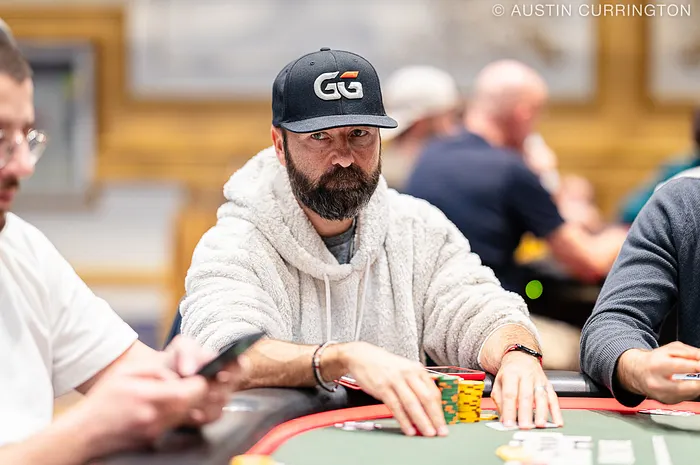
Was Poker Hall of Famer Daniel Negreanu playing game theory optimal (GTO) poker back in 2015?
GTO strategy has become a key component of poker in recent years, but most players weren’t aware of it a decade ago. Using GTO Wizard, let’s look at a hand from Day 5 of the 2015 World Series of Poker (WSOP) Main Event to see if the strategy on display holds up.
The Hand
The hand in question, which occurred with 210 players remaining, was between Negreanu and fellow Canadian Omri Moga with blinds of 8,000/16,000 with a 2,000 ante. The next place would pay $40,433, while $7.6 million was up top for the eventual champion.
Action started with Moga opening to 35,000 in the hijack off a stack of 850,000 holding A♥9♣. Negreanu defended in the big blind with K♣10♠ and a stack of just over 1,000,000.
Negreanu checked as the flop landed A♣Q♥4♥ and Moga bet 30,000 with his top pair. Negreanu check-raised to 85,000 his Broadway draw and Moga called. Both players then checked on the 3♥ turn.
The river brought the 7♠ and Negreanu bet out 225,000 after missing. Moga folded his top pair and Negreanu won the pot with king-high.
Pre-Flop Analysis
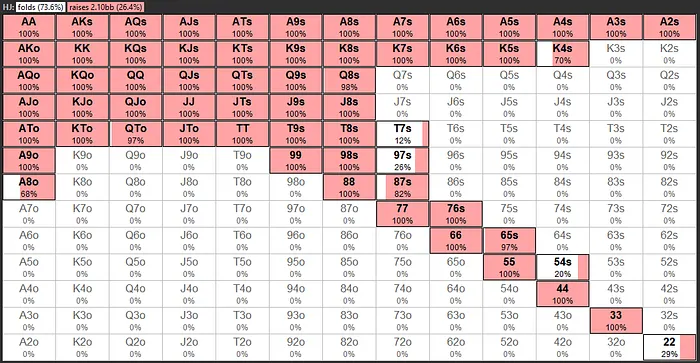
Moga opens to 35,000 in the HJ holding A♥9♣. Ace-nine offsuit is a pure raise from the HJ pre-flop. This is GTO-approved.
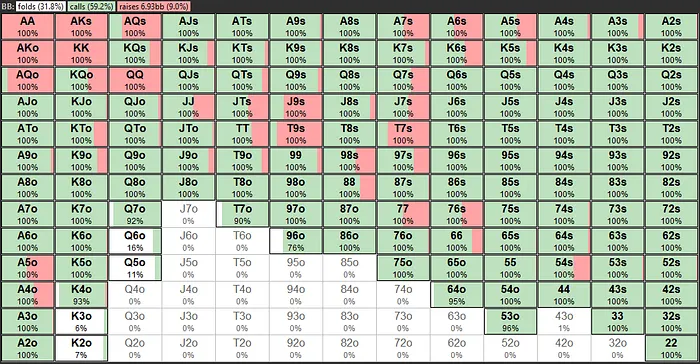
Negreanu defends from the big blind with K♣10♠. This is GTO-approved.
Both players make standard pre-flop decisions. Let’s now break down the post-flop action.
Flop Analysis
Flop (96,000 Pot): A♣Q♥4♥
Negreanu’s check is GTO-approved. Standard check range on this specific flop.
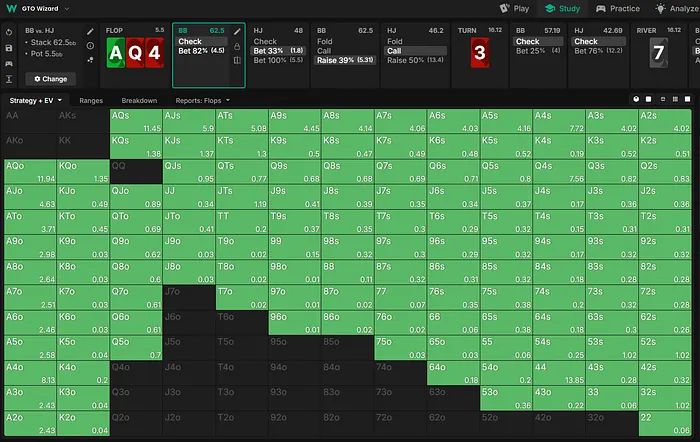
Moga bets 30,000 with A♥9♣. This is GTO-approved.
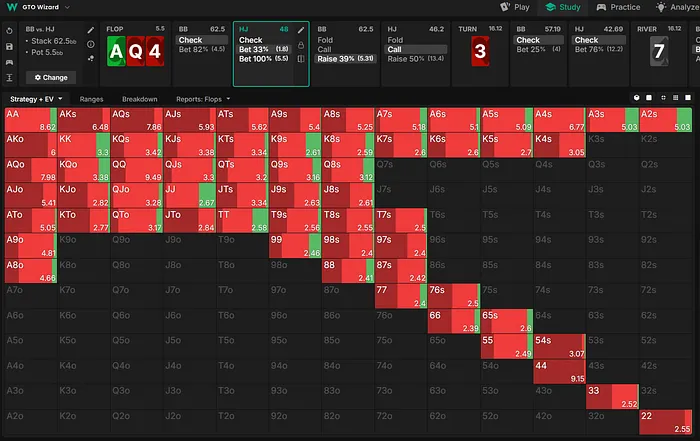
C-betting close to range on this flop from the hijack versus big blind.
Here is the recommended strategy and EV for ace-nine offsuit on the flop:
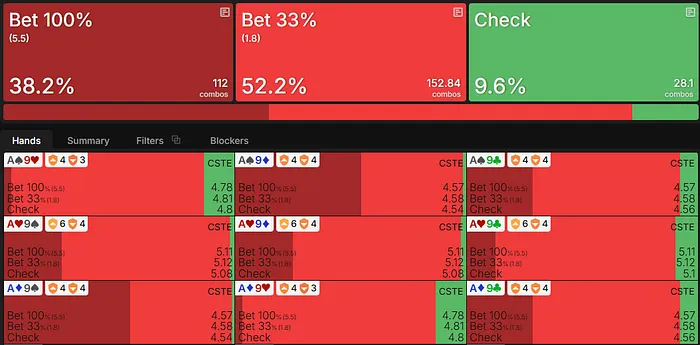
The solver recommends using a small bet (33%) and a large bet (100%) on this board. A♥9♣ leans toward the smaller size, as having the A♥ reduces the need for additional protection.
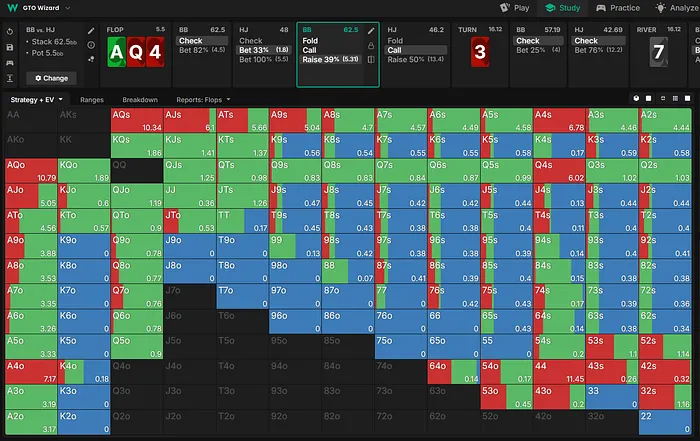
Unfortunately, it seems Negreanu wasn’t playing precise GTO poker back in 2015. His raise is not GTO-approved.
Here is the recommended strategy and EV for king-ten offsuit on the flop versus bet:
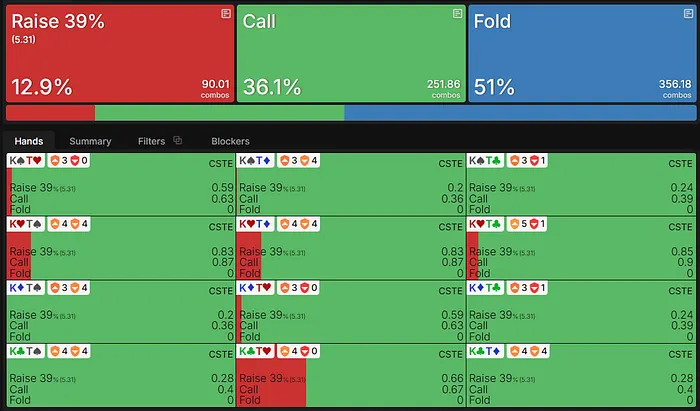
That said, some king-ten offsuit combos do check-raise at a small frequency, but these contain a heart, unlike K♣10♠. Negreanu is well known for his exploitative style and ability to read opponents, so let’s examine the lowjack range against this raise to see if it would realistically fold more often than the solver suggests.
Moga calls the 85,000 raise. This is GTO-approved.
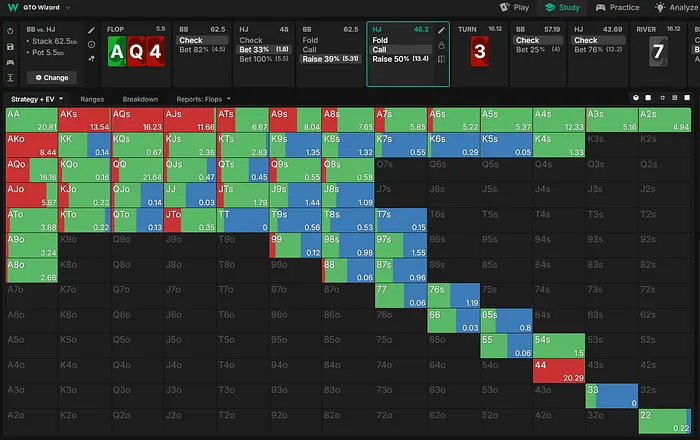
No hands with an ace fold to this flop raise. A♥9♣ opts for a standard call.
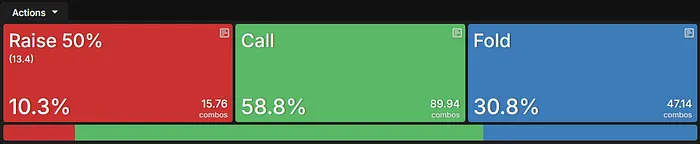
Against this raise, Moga is supposed to call with nearly 59% of his range. Let’s run a nodelock test, if I increase the fold percentage by, say, 10%, we can see whether K♣10♠ starts raising more as a result.
Here is the recommended strategy and EV for king-ten offsuit on the Flop vs a nodelocked over-folding range:
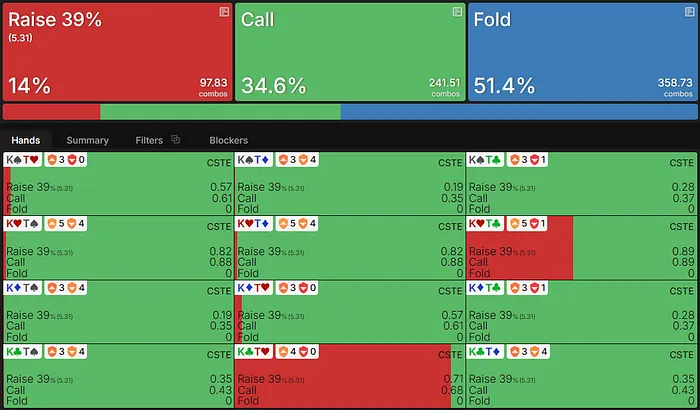
Even against this nodelocked range, the solver only recommends raising with king-ten offsuit combos that contain a heart. So, even if Negreanu believed his opponent was overfolding here, the solver still does not suggest using king-ten offsuit to raise this c-bet.
Since K♣10♠ wasn’t in the solver’s recommended raising range on the flop, I’ve nodelocked it to raise at a 50% frequency so we can analyse the optimal strategy for both players on the turn and river.
Turn Analysis
Turn (266,000 Pot): 3♥
Negreanu checks the turn with K♣10♠. This is GTO-approved.
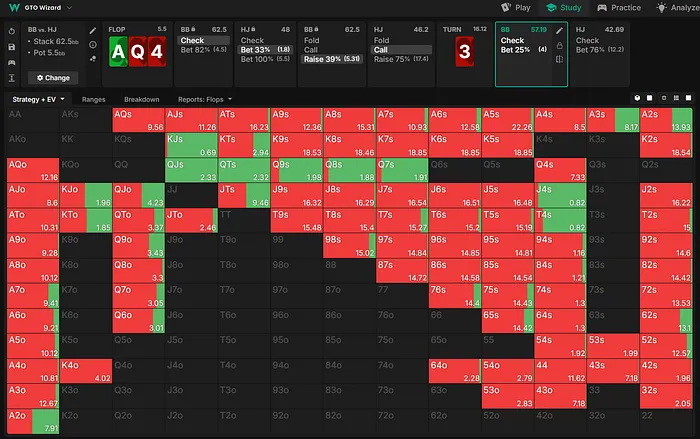
Although the solver recommends an 88% betting frequency for the BB’s range on this turn, K♣10♠ is one of the few combos that prefers to check.
EV for king-ten offsuit on the turn:
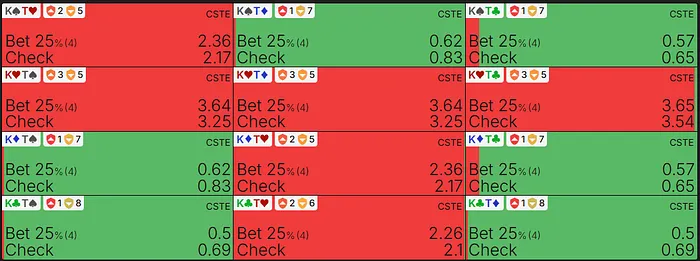
A simple strategy for all king-ten offsuit combos on the turn is to check when you don’t hold a heart and bet when you do. This is because king-ten offsuit lacks enough equity to bluff on the turn without a heart in hand.
Moga checks back the turn with A♥9♣. This is GTO-approved.
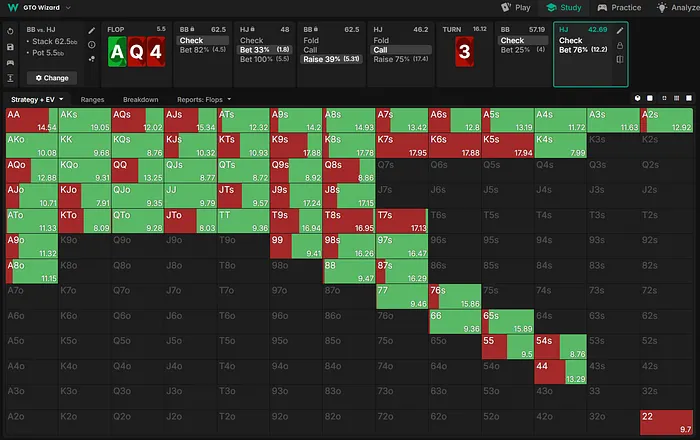
The solver recommends checking at a high frequency on this turn, as the big blind’s range isn’t capped and includes flushes that prefer to check.
Here is the recommended strategy and EV for ace-nine offsuit on the turn:
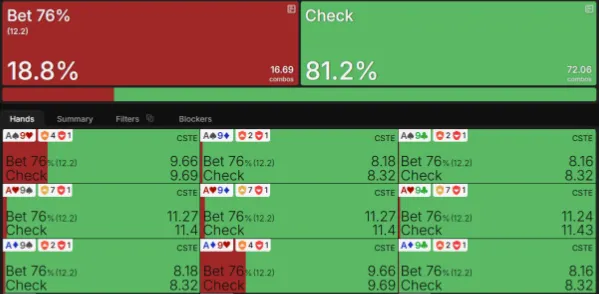
Checking with every ace-nine offsuit combo generates the highest overall EV on the turn.
River Analysis
River (266,000 Pot): 7♠
Negreanu bets 225,000 on the river with K♣10♠. This is not GTO-approved.
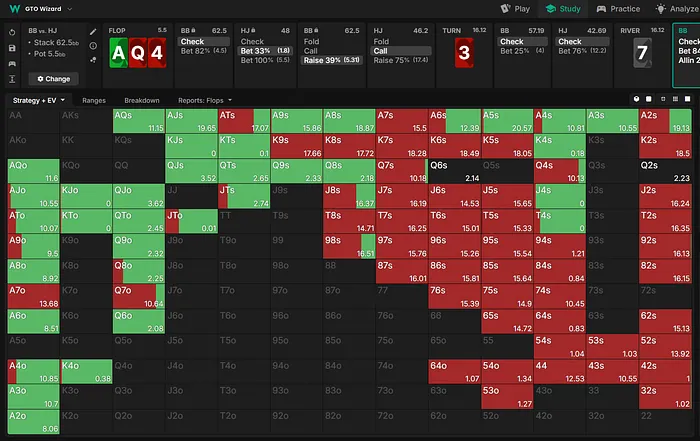
Unfortunately, another GTO mistake from Negreanu. The solver prefers using JTo as a river bluff, since this hand forces all the dominating combos such as QT, KT, KJ, and QJ to fold.
Here is the recommended strategy and EV for king-ten offsuit on the river:
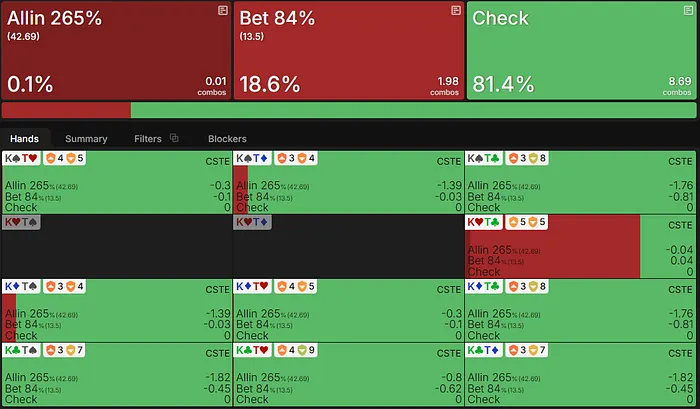
Here, betting with K♣10♠ has much lower EV than checking. However, in-game this bet did make ace-nine offsuit fold, and I suspect that theoretically, ace-nine offsuit shouldn’t fold to this bet size. Once we see Moga’s response, it would be interesting to give him more folds than theory suggests and see if K♣10♠ then prefers to bet on the river as a result.
Moga folds to the river bet with A♥9♣. This is not GTO-approved.
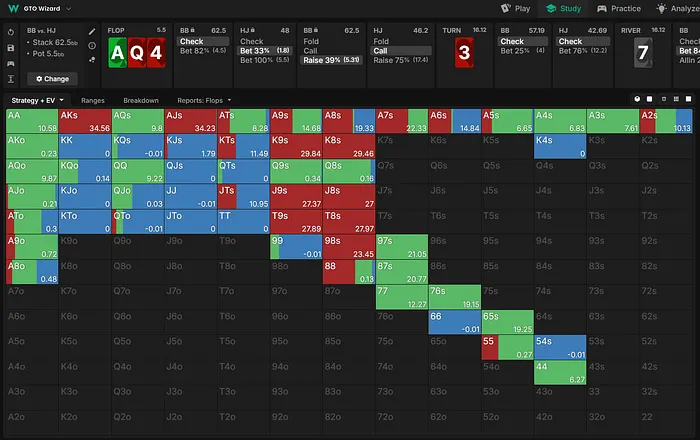
As we suspected, ace-nine offsuit mostly prefers to just call this river bet.
Here is the recommended strategy and EV for ace-nine offsuit on the river:
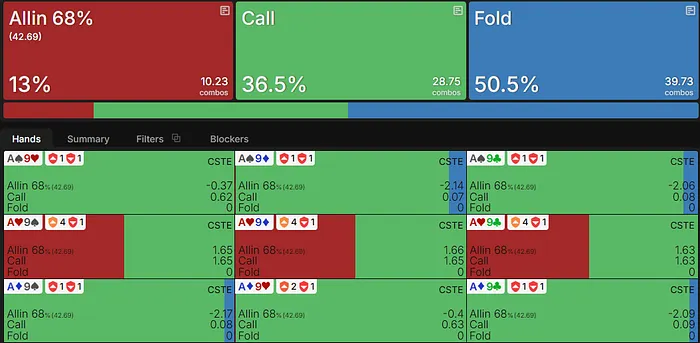
Folding has the lowest EV compared to calling or even going all-in as a bluff with A♥9♣. This is based on playing versus a solver-recommended range, but in reality, Negreanu included more bluffing combos on the river than the solver suggested. As a result, the EV of calling would increase, making folding even more costly in terms of overall EV.
I’ve nodelocked Moga’s range in raising his river folds from 50% to 75% against the 85% bet sizing, which will allow us to analyse what Negreanu’s optimal response should be in this scenario versus Moga’s actual in-game strategy.
Negreanu’s river response when Moga overfolds to a bet:
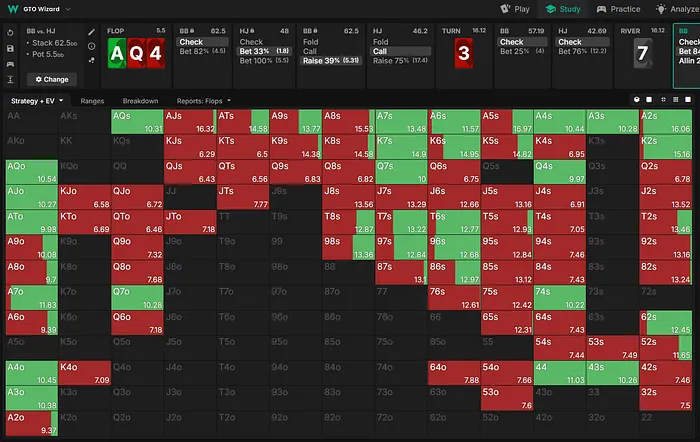
Unsurprisingly, Negreanu’s river check frequency drops from 81% to just 12%.
Here is the recommended strategy and EV for KTo on the river versus a 75% fold:
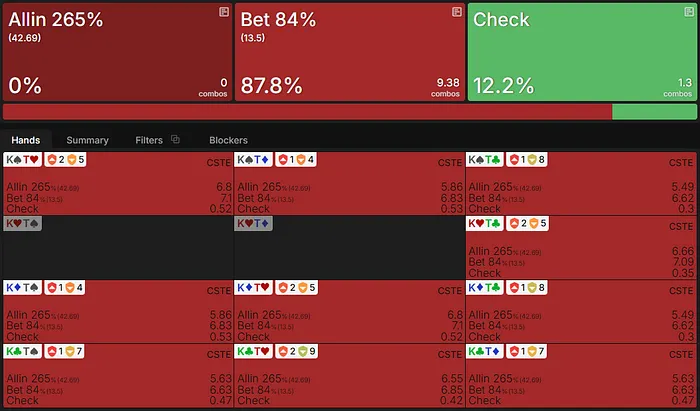
Now, all king-ten offsuit combos prefer to bet. The EV of betting K♣10♠ rises dramatically, from -0.45 to 6.63.
Conclusion
This hand is a classic example of why you shouldn’t follow solvers blindly and does support the theory that Negreanu has always been ahead of his time. According to the solver, Negreanu isn’t supposed to raise K♣10♠ on the flop or bet it on the river against an opponent playing perfect GTO.
However, in reality, most players, even today, don’t play perfect GTO, and in 2015, solvers were still new. Negreanu correctly recognised that his opponent was likely overfolding on the river, so he made the highest EV decision in-game by betting to force better hands to fold.
Many people dismiss GTO poker because they believe most humans don’t play close to GTO, and therefore assume solver outputs are useless. However, this is only true if you don’t use the node locking feature, as I did to analyse this hand.
This hand is a perfect example of why the AI node locking feature on GTO Wizard is so powerful, especially when reviewing your own hands against opponents who deviate from GTO strategy. If Negreanu had blindly followed the solver here, he wouldn’t have extracted the highest EV. That’s where nodelocking becomes invaluable.
By adjusting your opponents’ ranges to reflect how they actually play in-game, you can see the optimal GTO strategy for exploiting these tendencies. This makes studying real hands far more practical and bridges the gap between theory and real-world poker. The AI node locking feature also demonstrates that the claim that solver outputs are useless is simply not true!
Check out the full hand, which is available on YouTube around the 18:18 mark.
If you want to try out this AI feature on GTO Wizard to study your own hands, click the link to download GTO Wizard for free.