Warning: Undefined array key "post_type_share_twitter_account" in /var/www/vhosts/casinonewsblogger.com/public_html/wp-content/themes/cryptocurrency/vslmd/share/share.php on line 24
Modern-day players strive to play GTO poker. They want to play a good, fundamentally solid strategy, and they are more or less successful in accomplishing this goal.
However, in large-field tournaments, especially the ones with lower buy-ins, beyond understanding basic principles, you also need to exploit what your opponents are doing incorrectly.
Whether it is a low buy-in WSOP event or your local re-entry tournament, the fact of the matter is that people will be making mistakes left and right.
Solvers becoming more accessible has allowed many players to improve their GTO fundamentals, but by always trying to do what the solver says is correct, they often leave a ton of money on the table.
In this article, I’ll go through five key exploits you can implement when playing in large-field tournaments and any tournaments with softer fields, such as daily events at your local poker room.
#1 Over-Fold Against River Bets
One thing that I mention often in my strategy lessons is that most players don’t bluff nearly often enough on the river, especially when there are not many draws that have missed.
Say the board runs A-Q-9-6-2, and your opponent bets all three streets. While there are a couple of gutshot straight draws they could be doing this with, much more often they’ll be betting with a top pair or better, going for value.
So, if you have a pair of queens or even a bad ace in this situation, folding is the right move. In the GTO world, we are never folding an ace here, but if the player sitting across from you will never value bet anything worse than a top pair, and they’ll never bluff with random suited connectors that turned a backdoor flush draw, you need to get out of the way.
Your bluff catchers, i.e., hands that lose to all value bets, are simply not good enough to call with here. You should still call with a hand like AJ, since your opponent could be going for value with a worse ace, but your worst aces and especially middle pairs are trivially easy folds.
Of course, you should always consider your specific opponent, too. Sometimes, you can tell they are trying to pull a bluff, and you should be aware of these situations. But, generally speaking, people are not looking to bust tournaments, and it takes a lot of fortitude to run an all-in river bluff, especially if there is a money bubble looming.
#2 Under-Bluff the River When Lots of Draws Miss
In spots where the board runs out so that a lot of draws miss or the texture doesn’t change substantially, your opponents’ marginal made hands will have decent equity.
When you bet the flop and the turn, your opponents will assume your range is polarized, and, in today’s poker climate, most players understand that, when you are polarized, and there is a decent number of busted draws, you’ll have a lot of bluffs.
For example, you raise before the flop, the big blind calls, and the flop comes 9-8-3 with two spades. Your opponent check-calls your flop bet.
The turn is another 3, and, once again, they check and call.
The river comes a 2. The board hasn’t really changed. So, by betting here, you’re saying you have at least a decent nine, but you can also have all the missed straight and flush draws, as well as all the random hands like KJ that decided to go for it.
No decent opponent will ever fold a pair of nines here, and they are probably not folding any eights, either. Some might even look you up with an ace high.
All of this means that you should be under-bluffing in these spots. Even in the GTO world, we are not betting some spots with a busted flush draw, because if we have a draw, it is less likely that our opponent is on a draw.
Many players don’t like the idea of betting the flop and the turn and then just giving up on the river with something like queen high. However, if you’re bluffing with every busted draw on the river, you’ll be drastically over-bluffing.
#3 Value Bet Thinly
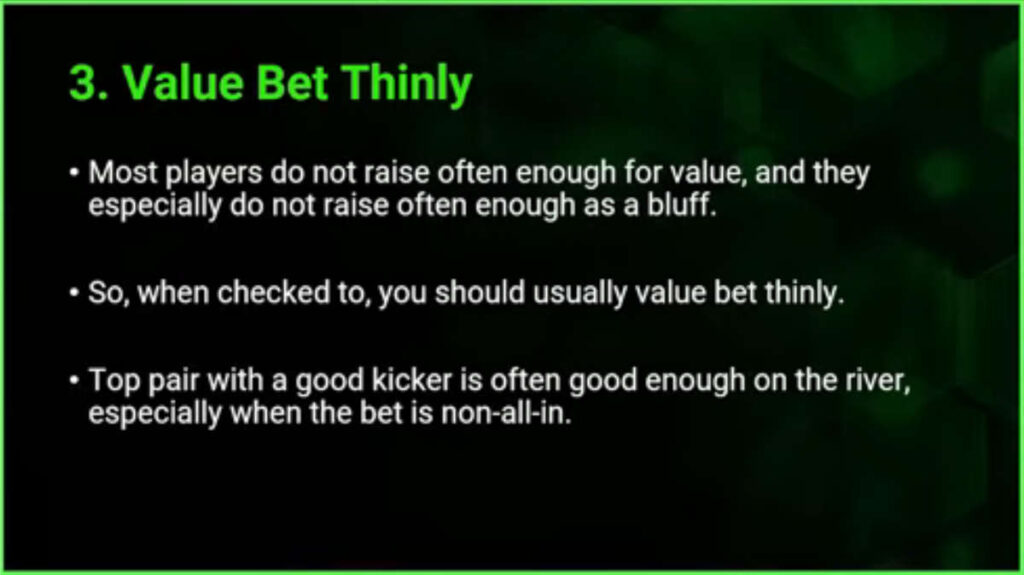
In large field tournaments, you want to make it a point to value bet thinly. When you do this and your opponents call with worse, you are putting in the money as a favorite, which is exactly where you want to be.
This strategy only backfires when they raise adequately for value and as a bluff, but most people are not doing this, especially as stacks get medium-sized or shallow. They’ll usually check and call with hands like a top pair – good kicker, and when they do raise, they’ll have a strong, polarized range.
Since this is the case, you don’t have to worry about getting raised off of your hand when they check to you. You are free to bet more often to realize your equity and extract as much value as possible with your decent hands.
Even a hand like a middle pair with a good kicker is often decent enough to bet with if your opponents won’t raise you, and a top pair with a solid kicker is a great spot to value bet on the river.
Simply put, if your opponents will call somewhat adequately or they are even a bit of a calling station on the river, and you know they won’t check-raise with logical blocking cards, you should be going for thin value.
#4 Fold Marginal Hands When Raised
This exploit ties right into the previous one. When you value bet on the river and get raised, you should drastically over-fold with your marginal made hands. Your opponents’ raising range will be tilted heavily toward value, and your hand doesn’t do well against that particular range.
Many players take this to mean that they shouldn’t value bet in the first place, but that’s wrong. Your opponents will call a lot, giving you plenty of value, and in the rare instances that they do raise, you can comfortably fold, knowing you’re probably crushed.
Yes, this is a very exploitable strategy, and it won’t work against balanced players, but against someone who doesn’t bluff often enough, you can make a lot of money by value betting thinly on the river and folding when they raise.
#5 Use Block Bets to Induce Raises from LAG Opponents
More and more players are starting to realize that, after the action goes check-check on the turn, the right play from out of position is to bet tiny (like one or two big blinds) with marginal made hands (85%), super nuts (10%), and a few bluffs.
Many loose-aggressive players will see this bet and put you on a medium strength hand, thinking that you’ll never call their raise. They hate the idea of giving up the pot for such a small bet, and they can’t win by calling with a jack-high or a ten-high, so they’ll go for a raise instead.
You can count on these players to have too many bluffs, which means your bluff catchers become profitable calls. You’ll want to look these players up wider than the GTO strategy suggests, simply because they don’t want to fold, they can’t call, so the raise becomes the only option in their minds.
Of course, you need to find the right players to do this against. Some of your opponents will still give up with their junk holdings and only raise you with strong hands, in which case you can bet tiny and fold. But, against LAGs, this strategy can make you a lot of money.
So, to sum it up, in large tournaments, you’ll want to exploit players you’re up against and do things that play into whatever they do incorrectly. Whether they fold too much, bluff too often, or whatever else, you’ll want to take advantage of those flaws and turn them into an advantage for you.