Warning: Undefined array key "post_type_share_twitter_account" in /var/www/vhosts/casinonewsblogger.com/public_html/wp-content/themes/cryptocurrency/vslmd/share/share.php on line 24

Before jumping into troubleshooting, you need to verify what kind of site you are trying to fund. If you are playing at a locally licensed PAGCOR casino (like BingoPlus or localized eGames), GCash payments usually process well because they operate natively within the Philippine financial system.
However, if you are playing at an offshore casino, your deposits must pass through international payment gateways. These international routes put your transactions directly in the crosshairs of Philippine regulatory filters designed to block unregulated gambling transfers. For players using offshore casinos, GCash payment failures mostly come down to these strict regulatory changes, not technical glitches. Knowing the difference between a problem on your end and one baked into the system is the whole point of what follows.
Why GCash casino payments fail: the real reasons
Most troubleshooting guides jump straight to “clear your cache” and “check your balance.” Those steps are worth trying, but they almost never get to the root cause for players at offshore casinos. There are four distinct reasons a GCash payment can fail at an offshore site and only some are fixable.
1. The August 2025 BSP directive
In August 2025, the Bangko Sentral ng Pilipinas (BSP) issued new rules regarding GCash online gambling, telling the e-wallet and Maya to pull all direct links to casino sites. GCash complied on August 16, 2025, killing off GLife – a built-in mini-app dashboard that previously let users launch and fund games directly from the platform.
Put simply: if you are trying to deposit at a casino directly through the GCash app’s built-in casino section, that route is gone. The casino’s own cashier page, accessed through a browser, runs on a different payment flow and may still work depending on how the operator processes GCash payments.
2. BSP Gcash online gambling merchant code blocking
This is the most common cause of failures players can’t fix themselves. GCash, regulated by the BSP, blocks transactions flagged with a gambling-related merchant category code (MCC). When an offshore casino runs GCash payments through a gateway using a gambling MCC, the transaction gets rejected at BSP level before it ever touches your account.
Offshore casinos that route their payments through a general retail or services merchant code, rather than a gambling-specific one, tend to process GCash deposits without issue. Those that have not set this up will consistently fail, no matter your account status, balance or device.
You can’t fix this from your end. If a casino’s GCash integration is blocked at the merchant code level, no amount of troubleshooting will change that – if you have funds but the deposit fails twice, it’s an MCC block. You will need to either use a different deposit method or pick a casino whose payment setup gets around the restriction. Our GCash casino payments page tracks which sites currently process GCash gambling deposits without issues.
3. Unverified or partly verified GCash account
GCash has three verification tiers. Unverified accounts are capped at ₱100 and can’t send money to most merchants. Basic verified accounts max out at ₱50,000 per month. Fully verified accounts (you will need a valid government ID and a facial recognition scan) get a monthly wallet limit of ₱100,000 and access to everything GCash offers.
Plenty of deposit failures at offshore casinos simply come down to hitting a wallet or transaction limit on a partly verified account. This one is fixable.
| Verification Level | Monthly Wallet Limit | Send Money Limit | Casino Deposits |
|---|---|---|---|
| Unverified | ₱100 | Very limited | Not practical |
| Basic Verified | ₱50,000/month | ₱50,000/month | Limited by cap |
| Fully Verified | ₱100,000/month | ₱100,000/month | Full access |
4. Technical and account-level issues
A smaller share of failures are genuinely technical: app bugs, outdated versions, shaky connections or temporary GCash outages. These are the ones that normal troubleshooting actually helps with.
What You Can Fix: Troubleshooting Steps
Go through these in order; the first three resolve most account-level and technical failures.
- Check your GCash verification level. Open the app, go to your profile and look at your current tier. If you are on Basic Verified or below, the monthly transaction cap could be blocking your deposit. Upgrade to Fully Verified by submitting a government-issued ID (passport, driver’s licence, or PhilSys ID) and completing the in-app facial scan. Approval usually takes 24 to 48 hours.
- Check your remaining wallet limit. Even fully verified accounts have a ₱100,000 monthly cap. If you have already pushed that amount through your wallet this month, counting all transactions and not just casino deposits, further transfers will fail. Pull up your transaction history in the app to see where you stand for the month.
- Check the online casino’s GCash payment route. Some offshore casinos process GCash via QR code, others via direct bank transfer using the casino’s GCash-linked mobile number and others via a third-party payment gateway. If one method fails, try another. Look for alternative GCash deposit options in the casino’s cashier section or message support to ask which method currently works for Philippine players.
- Update the GCash app. Running an old version can cause errors when you try to log in or complete a transaction. Head to the App Store or Google Play, grab any pending updates and retry.
- Check your internet connection. GCash transactions time out on unstable connections. Switch from mobile data to Wi-Fi (or the other way around) and try again. Avoid depositing at busy times if you are on a congested network.
- Try from a different device. GCash ties authentication to one registered device. If you recently switched phones or logged in from multiple devices, transaction verification can break. Stick to the primary registered device.
- Check GCash system status. Periodic outages knock out all transactions. Look at GCash’s official status updates or the in-app notification centre for reported service interruptions before pointing fingers at yourself or the casino.
- Contact the casino’s support first. If GCash shows no failed transaction on your end (no deduction, no error message in your history), the issue is at the casino’s payment gateway. Reach out to casino support with the time of your attempt, the exact amount, and your GCash mobile number. Specifically ask support if their current gateway is actively accepting GCash for Philippine players right now. If they actually check their gateway logs, they can give you a straight answer. If they just give you a generic “clear your cache and try again later” without looking into it, they are deflecting – save your time and switch to another payment method.
- Contact GCash support if funds were deducted but never arrived. If your GCash balance dropped but the casino never got the deposit, open a ticket in the app under Help > Report a Problem. Include the transaction reference number, the amount, the time, as well as who the payment was sent to. GCash usually resolves disputed transactions within 7 to 10 business days.
What you can’t fix: when to switch methods
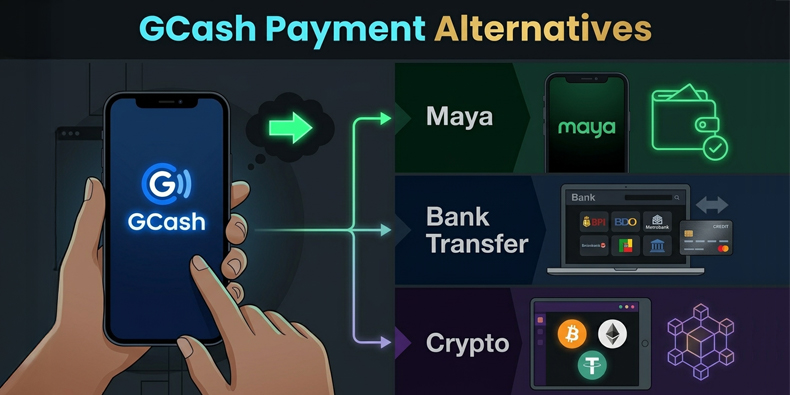
If you have gone through everything above and GCash keeps failing at a specific casino, merchant code blocking is almost certainly the reason and there is nothing you as a player can do about it. The casino’s payment processor is either tagged as a gambling merchant under BSP rules or the operator has not set up alternative routing that sidesteps the restriction.
Here is what to try instead:
- Maya (formerly PayMaya) falls under the same August 2025 BSP directive as GCash, so it hits similar walls at some offshore casinos. Nevertheless, the merchant code landscape differs between the two platforms and some casinos that consistently fail with GCash handle Maya deposits fine. It is worth a shot as your first alternative. Visit our Maya casino payments page for a list of reliable sites.
- Direct bank transfer via InstaPay or PESONet works at offshore casinos that list Philippine bank accounts as a deposit option. Deposits usually land within a few hours. Some Philippine banks now flag gambling-related transfers for review, so there may be occasional holdups but bank transfers tend to be more dependable than e-wallets at offshore sites recently.
- Cryptocurrency, mainly Bitcoin and USDT, is the most consistent deposit method at offshore casinos for Filipino players right now. Transactions skip local banking restrictions altogether, go through in minutes and are not subject to BSP merchant code rules. The downside: transactions can’t be reversed, there is no chargeback protection and volatility affects the value of whatever you are holding. You can buy crypto through peer-to-peer exchanges using GCash as the funding source, a common workaround to get money into casino accounts indirectly. To see which offshore sites actually process Bitcoin and USDT reliably, check out our list of top crypto casinos in the Philippines.
Conclusion
A failed GCash casino deposit is almost never just a technical hiccup. The August 2025 BSP directive and ongoing merchant code restrictions mean some offshore casino payment failures are baked in, the result of regulatory decisions that updating your app or checking your balance won’t fix.
The troubleshooting steps above will sort out the problems that can be sorted: verification limits, outdated apps, dodgy connections, and gateway errors. For everything else, a different payment method will get you further than repeated GCash attempts at a casino whose payment setup clashes with BSP requirements.
Picking an offshore operator with solid payment infrastructure for Philippine players, whether that is working GCash integration or strong alternatives, is just as important as any other factor when deciding where to play. Our Philippines casino page is a good place to start.
Frequently Asked Questions
Here are the answers to some of the questions currently being raised by players around the topic of GCash gambling.


